By


BERLIN — Hands outstretched, shoulders rocking, limbs transformed into living glowsticks, a body of bodies bob in unison. Some march in matching Converses; some twist in black-lit button-downs; some flagellate their fingers in flesh-toned leotards. Buzzcuts bleed into gray goatees; teased bangs swirl into flowing locs; a scrunchied ponytail whips into a pompadour. Each ensemble locks into ardent formation; flickering brows lift toward the heavens. Experiencing the full 35 minutes of Jeremy Shaw’s “Phase Shifting Index” (2020), an epic seven-channel video installation on view in Berlin’s Hamburger Bahnhof, is like being baptized in a sea of sacramental strobe lights.
The work is of a piece with the ecstatic oeuvre of the Berlin-based Canadian artist, who was born in North Vancouver in 1977. His religious upbringing manifests in video and sculptural pieces that read as at once transcendent, trippy, and implicitly queer, and have been shown in solo exhibitions at institutions like Centre Pompidou and Musée d’art contemporain de Montréal in 2020 and MoMA PS1 in 2011, and included in international exhibitions like the 2017 Venice Biennale and Manifesta in 2016. I spoke to Shaw over Zoom about spirituality, ritual, and the liminal spaces between play and reverence. “I used to blanket my practice as being about ‘altered states’ — looping questions around neuroscience and the age-old notion of transcendence, escape from the body,” Shaw explained, “but these days I speak more about faith and belief.”
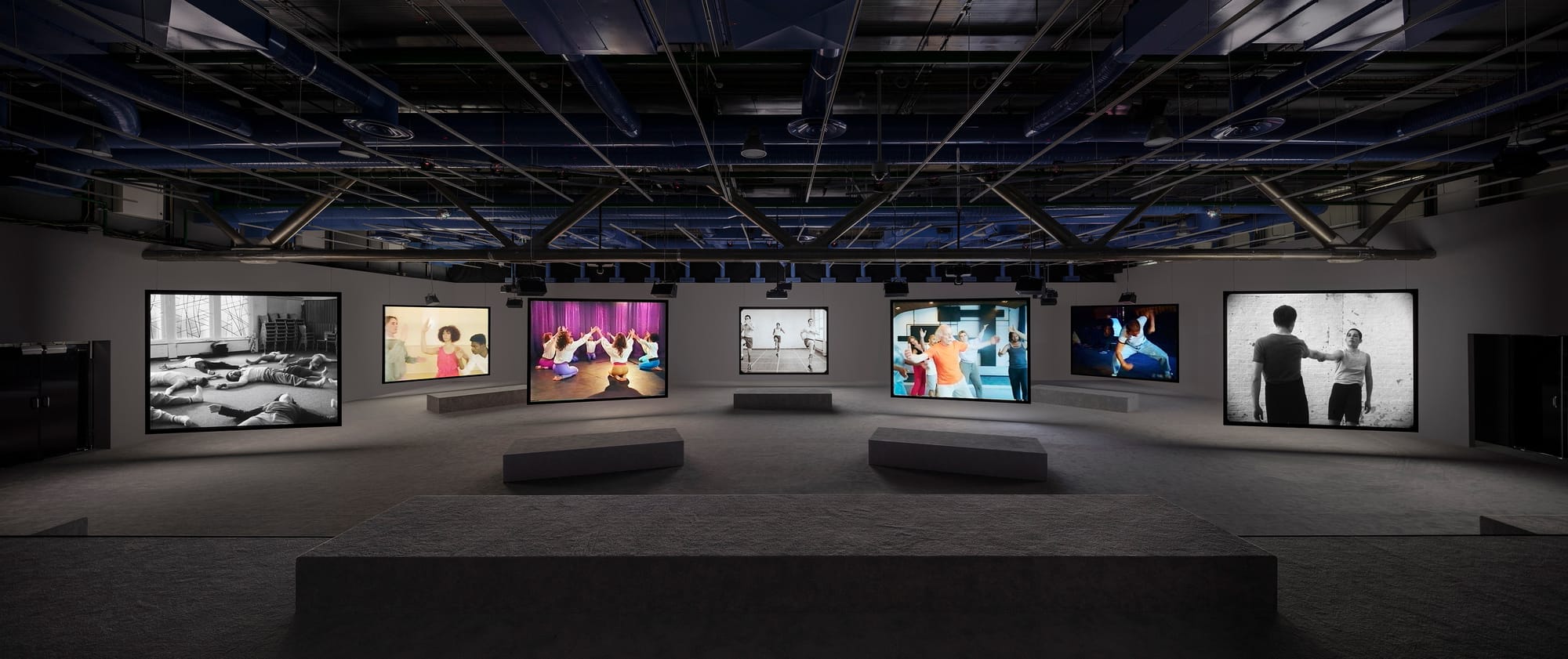
In "Phase Shifting Index," transcendence is both of and beyond the body. Seven dance troupes — distinct in historic era, cultural context, and choreographic style — are depicted rehearsing, experimenting, catharting, and bonding. They move in separate spheres across the gallery, but when (magically, miraculously) they come together, they explode into a kinesthetic kaleidoscope of energy, only to digitally deliquesce into candy-colored pixels.
“If you could empirically explain what’s happening to a human brain during a spiritual experience,” Shaw asked, “would that validate the experience or discount it?” This celestial dissolution of body and spirit may speak to Shaw’s religious upbringing in Vancouver in the 1980s. "I was raised Catholic and wanted to have a mystical experience at a young age,” Shaw shared, “even though I grew up gay, and knew there was something off about the system as well. But the desire for that experience is inherent.”
https://hyperallergic.com/jeremy-shaw-dances-with-the-divine/