 By
By 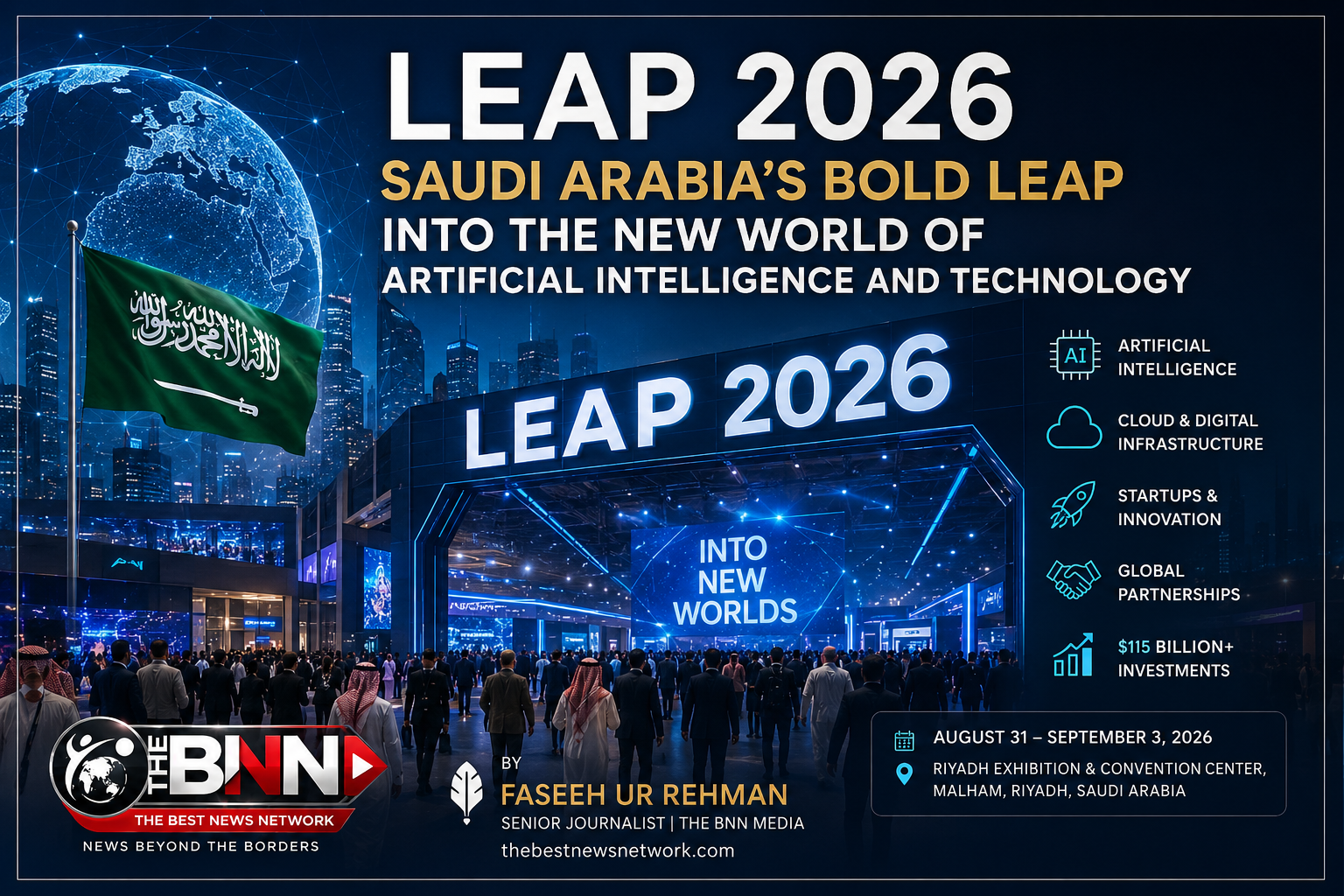
By Faseeh Ur Rehman
Senior Journalist | The BNN Media – The Best News Network
News Beyond the Borders
Riyadh has once again demonstrated that the future of technology is not something to be watched from a distance—it is something to be built, invested in and led.
The fifth edition of LEAP 2026, held from August 31 to September 3 at the Riyadh Exhibition and Convention Center in Malham, brought together an extraordinary concentration of technology companies, investors, entrepreneurs, policymakers and innovators under the powerful theme “Into New Worlds.”
What emerged from the four-day event was much more than another international technology conference. LEAP 2026 offered a compelling picture of how Saudi Arabia is positioning itself at the center of the global transformation driven by artificial intelligence, advanced computing, cloud infrastructure, digital economies and emerging technologies.
A Technology Gathering of Global Scale
The scale of LEAP 2026 was remarkable.
Organizers brought together more than 1,000 speakers, 1,800 global technology brands, 600 startups and approximately 1,900 investors, with discussions spanning artificial intelligence, cybersecurity, fintech, health technology, smart cities, space, gaming, mobility and digital infrastructure.
For entrepreneurs, the event represented access to capital and international markets. For investors, it offered a window into rapidly developing technologies. For governments and policymakers, it demonstrated how digital infrastructure and artificial intelligence are becoming central components of economic strategy.
And for the wider world, LEAP presented an increasingly important question:
Who will shape the next era of technological development?
Saudi Arabia clearly intends to be among those shaping it.
From Vision to Execution
Perhaps the most significant aspect of LEAP 2026 was not the number of companies occupying the exhibition halls, but the evidence that Saudi Arabia’s technology ambitions are increasingly moving from vision to execution.
During the event, announcements, investments and agreements approaching $15 billion were unveiled across AI infrastructure, data centers, cloud computing, technology manufacturing and venture capital.
This is particularly significant because artificial intelligence is no longer simply a software story.
The AI economy requires enormous amounts of computing power, data-center capacity, semiconductor infrastructure, energy, cloud services and highly skilled human capital.
Saudi Arabia is attempting to build that entire ecosystem.
The country’s approach therefore extends beyond encouraging startups. It involves creating the physical and digital infrastructure upon which the next generation of AI businesses can operate.
Artificial Intelligence at the Heart of LEAP
Artificial intelligence dominated many of the conversations at LEAP 2026.
The dedicated DeepFest program placed AI at the center of discussions about the future of business, government and society, while other LEAP tracks examined applications of emerging technology across healthcare, finance, education, smart cities and other sectors.
The significance of this development cannot be underestimated.
AI is moving rapidly from experimental laboratories into everyday economic activity. Businesses are using it to automate operations, governments are exploring AI-enabled public services, and entrepreneurs are developing new products around generative AI and intelligent automation.
Saudi Arabia’s strategy appears to recognize that possessing AI applications alone is not enough.
The real competitive advantage will increasingly belong to countries capable of developing the infrastructure, talent and institutions necessary to operate AI at scale.
Billions Behind the Digital Infrastructure
One of the strongest messages from LEAP 2026 was the enormous investment required to support the AI revolution.
Among the announcements reported at the conclusion of the event was Amazon Web Services’ planned investment of more than $5.3 billion in its first cloud infrastructure region in Saudi Arabia, expected to launch in December 2026. AWS also announced an expanded partnership with HUMAIN involving substantial computing capacity for AI development.
Other major projects included investments in data centers and digital infrastructure.
These developments demonstrate an important reality: the future of AI will not be determined solely by whoever creates the most impressive model.
It will also depend upon who controls the infrastructure capable of running those models efficiently, securely and at enormous scale.
Adobe and the Future of Creative Technology
Another major announcement came from Adobe, which committed more than $4 billion as part of an expanded partnership involving Saudi Arabia’s Ministry of Communications and Information Technology and HUMAIN.
The partnership also includes plans to make Adobe’s creative AI tools available to millions of eligible citizens and residents and to develop an image-generation model reflecting Saudi culture and local context.
This is an especially interesting development for the global creative industry.
Artificial intelligence is fundamentally changing how journalists, filmmakers, designers, advertisers, photographers and content creators work.
But the next stage of AI development will not simply be about generating content faster.
It will increasingly be about creating technology that understands language, culture, identity and local context.
That makes developments such as culturally adapted AI particularly significant for the Arab world and other non-English-speaking markets.
Saudi Arabia’s Wider Technology Ambition
LEAP 2026 also needs to be understood within the larger transformation taking place under Saudi Vision 2030.
Saudi Arabia has been working to diversify its economy, develop new industries and strengthen its position as a global center for technology and investment. LEAP has become one of the most visible international platforms through which that ambition is presented to the world.
The evolution is notable.
What began as a technology event in Riyadh in 2022 has developed into a broader global technology movement, with LEAP expanding its international presence through LEAP East in Hong Kong.
This growing East-West connection could become increasingly important as technology ecosystems in Asia and the Middle East become more closely connected.
Beyond the Exhibition Floor
The real legacy of LEAP 2026 may ultimately be measured not by the number of visitors who entered the exhibition halls, but by what happens after they leave.
Will startups secure investment?
Will international companies establish operations in the region?
Will partnerships become functioning businesses?
Will new AI products emerge?
Will young Saudi entrepreneurs develop globally competitive companies?
These are the questions that will determine whether LEAP becomes simply a successful technology exhibition—or a genuine catalyst for long-term economic transformation.
Technology conferences can generate headlines.
Technology ecosystems generate history.
LEAP is increasingly attempting to build the latter.
A Message for the Next Generation
Perhaps one of the most important dimensions of LEAP 2026 is its message to young people.
The global technology economy is changing rapidly. Artificial intelligence is transforming traditional career paths while simultaneously creating entirely new professions.
For young people in Saudi Arabia, Pakistan, the wider Middle East and across the developing world, the lesson is clear:
The future will belong not only to those who consume technology, but to those who understand it, build it and use it to solve real problems.
The opportunity is enormous—but so is the responsibility.
The AI revolution must ultimately translate into better education, stronger healthcare, smarter cities, productive businesses, new employment opportunities and improved quality of life.
That is where technology moves beyond innovation and becomes meaningful development.
LEAP 2026: Into New Worlds
As LEAP 2026 concluded on September 3, Saudi Arabia left behind a powerful statement of technological ambition.
Nearly $15 billion in investments, agreements and announcements demonstrated the growing scale of the Kingdom’s digital economy. Meanwhile, the announcement that the next edition will take place from April 12–15, 2027 signals that the momentum is far from over.
The theme “Into New Worlds” therefore feels particularly appropriate.
The world emerging from today’s technological revolution will be fundamentally different from the world that entered it.
Artificial intelligence will redefine industries.
Cloud infrastructure will become strategic infrastructure.
Data centers will become essential components of national economies.
Digital talent will become one of the most valuable resources.
And countries capable of combining vision, investment, infrastructure and human capital will have an opportunity to shape the global economy of the coming decades.
LEAP 2026 has shown that Saudi Arabia does not intend to wait for that future to arrive.
It intends to build it.
By Faseeh Ur Rehman
Senior Journalist
The BNN Media – The Best News Network
“News Beyond the Borders”