
 By
By 
Report by FASEEH UR REHMAN, Senior Journalist, THE BNN
Introduction
Faseeh Ur Rehman provides a professional connotation on how current AI is evolving far beyond simple chatbot interfaces. This new era sends and generates complex technologies, expanding into institutional environments and developing new performative and embodied models that are actively taking on real-world tasks.
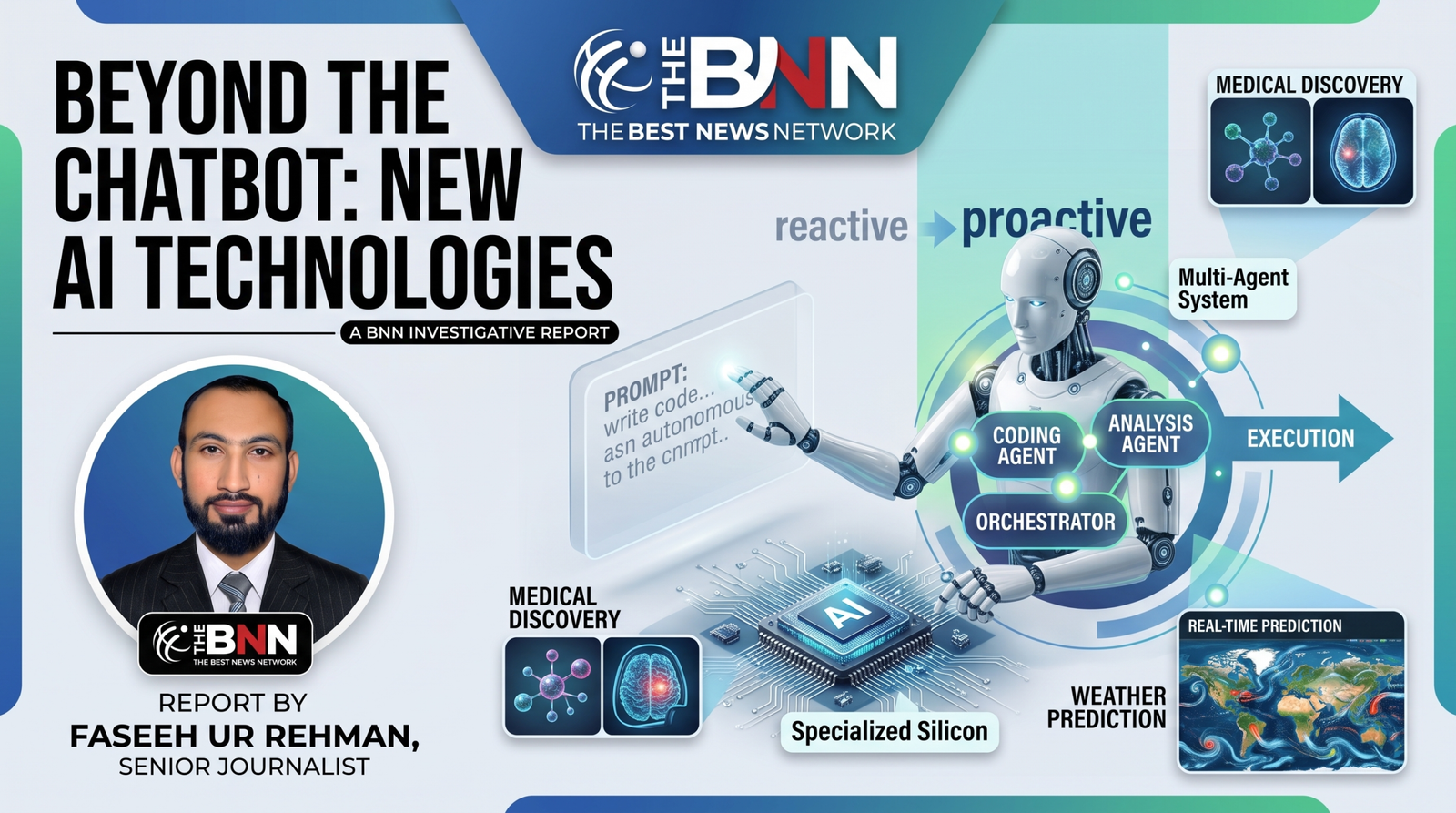
We are currently transitioning from reactive, text-based systems to proactive, autonomous, and physically embodied artificial intelligence.
1. Agentic AI Systems
Autonomous agents represent a shift from purely passive assistants to systems that are experientially autonomous, handling communication, planning, and execution. The goal is to enhance the law-to-order ratio that defines these new agentic AI systems.
A. Autonomous Agents and Multi-Agent Systems (MAS)
Under a Multi-Agent System (MAS) architecture, specialized agents cooperate to solve complex challenges:
- Coding of technologies: Specific agents dedicated to writing and debugging code.
- Coding operational integration: Agents that integrate new software into existing workflows.
- Analysis of accommodations and additional information: Agents focused on gathering and synthesizing peripheral data.
B. Sub-Agents and Task Delegation
Central AI agents or tasks serve as directors, breaking large objectives into manageable sub-tasks:
- Task processing: Sub-agents are directed to work on specific software or text-based tasks.
- Specialized analysis: Individual agents are tasked with niche analysis for specific applications.
2. Physical AI and Embodied Robotics
Physical AI represents the arrival of advanced multi-jointed robotics—systems that learn by actively interacting with objects in their physical environment. This interaction is facilitated by secured security robots and represents significant progress in integrated international engineering.
A. Learning by Interacting
Unlike statically programmed industrial robots, these AI systems develop through continuous interaction:
- Advanced manipulation: Learning assembly tasks and moving objects efficiently through manual dexterity.
- Dynamic sorting: Robots autonomously sort and categorize items, learning their context in a real-world setting.
B. The VLA Model Framework
The technological backbone of Embodied Robotics is the VLA (Vision-Language-Action) model. These networks take visual inputs (seeing the environment) and language instructions (understanding a command) and translate them directly into real-world physical action.
3. Compact Models and Specialized Silicon
The explosion of AI capability has outpaced traditional hardware. The solution is dual-pronged: developing more efficient software architecture (Compact Models) and building specialized hardware (Specialized Silicon) designed exclusively for AI tasks.
A. Efficiency Over Size
- Reduced Power: New microchips are designed specifically for reduced power consumption, minimizing operational costs and environmental impact.
- Centralized Minimization: A focus on maximizing processing power within smaller localized units, increasing efficiency.
B. Specialized Data Centers
Future data centers will rely entirely on this specialized silicon. These centers will use optimized microchips and centralized data processing units to handle the heavy training loads required by next-generation AI, utilizing specialized cooling and power solutions.
4. Global Impact
The practical application of these new AI technologies is already visible across critical sectors through detailed case studies.
- Medical Advancements: The new merge in medical AI models uses AI to drastically speed up data monitoring and disease diagnosis. Specialized models focus on innovative medical design, creating novel molecular structures for targeted drug development.
- Environmental Monitoring & Climatology: Next-generation AI is used to create hyper-detailed weather forecasting maps. These models analyze massive climate datasets to identify extreme weather patterns and calculate the risks of specific atmospheric conditions.
Conclusion
The technological shift we are observing from generative chatbots to the autonomous and embodied systems of Agentic AI, Physical Robotics, and specialized infrastructure marks a profound turning point in computational history. We are leaving the phase of technology merely mimicking human intelligence and entering an era where AI participates autonomously and securely in our physical and digital reality.
While the efficiency gains in medicine, environmental forecasting, and industrial robotics are massive, the immediate bottleneck is no longer a matter of model size, but rather one of systems integration and secure deployment.
For “The Best News Network,” this journalist concludes that the success of these new AI technologies will be judged not by their performance in academic benchmarks, but by their ability to safely execute complex decisions in unpredictable, real-world environments. The future of intelligence is no longer reactive—it is proactive, efficient, and increasingly embodied in the world around us.