By
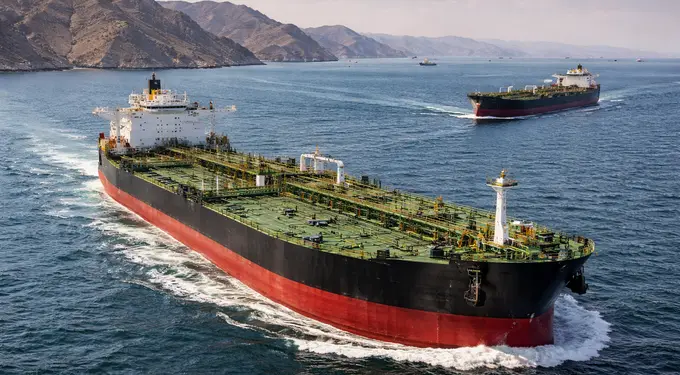
Four oil tankers were hit by explosions in the Strait of Hormuz this week, Iran’s military said, as attacks on shipping through the world’s most important oil waterway intensified and crude prices jumped — while Yemen’s Houthis said they had also struck Saudi energy infrastructure.
By Umar Farooq
Journalist (UAE) | The BNN Media – The Best News Network
News Beyond the Borders
DUBAI, United Arab Emirates — Four oil tankers were hit by explosions in the Strait of Hormuz, Iran’s military said on Thursday, 12 November 2026, adding that the vessels had ignored warnings and entered what it considers restricted areas of the strategic waterway. Oil prices rose sharply on the news, with Brent crude climbing about 1.3 per cent to $93.96 a barrel.

What Iran Says Happened
According to Reuters, Iran’s Revolutionary Guards Navy said two supertankers were disabled by explosions on Wednesday after they ignored warnings against using what it said was an “unauthorised route”. Iranian state media reported that the two vessels “exploded after hitting naval mines”, broadcasting what it said was video footage of the incidents.
Iran’s army later said two other tankers had hit mines on Thursday afternoon while sailing through the eastern Strait of Hormuz after ignoring warnings and disabling their radar systems, state television reported. The tankers entered a restricted area and subsequently caught fire, it reported.
Reuters said it could not immediately verify the Iranian military’s account, and no independent confirmation of the reported causes and circumstances was available.
Earlier in the US-Israeli war with Iran, which began in February, the IRGC Navy announced its attacks on tankers. More recently, however, it has instead reported that vessels have caught fire after hitting naval mines while traversing the southern part of the strait, which it has declared an unauthorised route.
A Separate Incident Confirmed by Monitors
In several of those earlier cases, the United Kingdom Maritime Trade Operations agency (UKMTO) — the Royal Navy centre that logs attacks on merchant ships — has said vessels had been struck by unknown projectiles.
UKMTO said in reports on Thursday that a vessel was hit by an unidentified projectile about 14 nautical miles northwest of the UAE emirate of Ras Al-Khaimah on Wednesday while exiting the strait, causing a fire in its engine room. Firefighting efforts were under way and all crew had been evacuated, it added.
The gap between what Iran claims and what independent monitors can confirm remains the central uncertainty in this story.
Attacks on Saudi Energy Sites
The tanker incidents came as attacks on energy infrastructure in the region intensified. That same day, Yemen’s Iran-aligned Houthis said they had attacked a pumping station on the Saudi East-West oil pipeline, an oil facility in the Saudi Red Sea city of Yanbu, and an Aramco building in the capital Riyadh, Reuters reported on Friday.
The Houthi claims have not been independently verified. But they underline how the conflict, which began in late February, has widened from the strait itself to energy facilities across the Gulf.
The scale of the shipping campaign is now substantial. At least 10 ships were hit in the first 10 days of November, after 37 attacks in October — the highest monthly tally since the conflict began — according to data from the Washington Institute for Near East Policy.
Oil Markets React — Then Pull Back
The latest maritime incidents moved international oil markets immediately. Reuters reported that Brent crude futures rose by approximately $1.20 per barrel on Thursday, reaching $93.96 per barrel during trading, a 1.3 per cent increase. US West Texas Intermediate crude also gained 53 cents, reaching $87.06 per barrel.
By Friday, however, prices were mixed and set for their second weekly decline, Reuters reported, as the United States plans to continue its Iranian blockade, reducing the chance of renewed large-scale fighting that could disrupt Middle East supplies — though attacks on shipping remain a danger.
Friday’s declines reversed two days of gains amid a volatile trading week. US President Donald Trump said on Truth Social that a deal with Iran was “not necessary” to end the war.
Why the Strait Matters
The Strait of Hormuz is one of the world’s most important maritime energy corridors. It connects the Persian Gulf with the Gulf of Oman and the Arabian Sea, and before the current conflict involving Iran, the United States and Israel, approximately one-fifth of global crude oil supplies passed through it.
Major oil-producing countries, including Saudi Arabia, Iraq, Kuwait and the United Arab Emirates, depend heavily on the route. Any prolonged disruption could affect international energy markets, increase transportation costs, and put pressure on fuel prices and electricity generation costs in importing countries across Asia.
Tankers are still facing attacks across the strait, despite a rebound in traffic and expectations of a de-escalation in the war between the United States and Iran that had been reflected in falling oil prices.
For shipping companies and energy traders, the message of this week is that the world’s most important oil chokepoint is still a war zone — and the risks have not gone away.

By Umar Farooq
Journalist (UAE) | The BNN Media – The Best News Network
News Beyond the Borders
Source: Reuters; This Dawn.