 By

Three days after a 34-point rout of Bucknell, No. 6 Virginia went on the road for the first time this season, a Friday night trip to College Park for the second game of a four-game series with Maryland. It was the Cavaliers’ third game in six days and their fifth in 11. Maryland, 1-1 in Buzz Williams’ second season, had not played since an 86-74 loss to Georgetown last Saturday. DraftKings opened Virginia as a 6.5-point favorite, with the line moving to 5.5 by tip.
For 20 minutes, almost nothing went right. Virginia turned the ball over eight times, sent Maryland to the free-throw line a whopping 24 times and did not make a three until late in the half. Feeding off a loud, near-capacity crowd of 16,908 at the Xfinity Center, the Terrapins led 47-36 at the break.
However, Virginia flipped a switch, and the second half belonged to the ‘Hoos. The Cavaliers shot 20-of-26 from the field, outscored Maryland 51-36 and took their first lead since early in the first half on a Chance Mallory step-back three. Virginia led for only 20 percent of the game, but it took the lead when it mattered most. The Cavaliers move to 5-0, Maryland falls to 1-2, and Virginia has now won 10 of the last 11 meetings against the Terrapins.
Here are my five takeaways.
Down 11 on the road, Virginia showed the grit of a top-10 team
This was a tale of two halves for Virginia, and the biggest difference was composure.
In the first half, Virginia looked rattled. It started 5-of-17 from the field, missed layups, threw the ball away in the half court and picked up 13 fouls. It seemed like on practically every possession Virginia was sending Maryland to the line, where the Terrapins made 19 of 24 free throws before halftime. The exclamation point was a three to close the half that put Maryland up 11 and sent the crowd into a frenzy.
In the second half, Virginia slowed down and went to work. Maryland had no answer for its pick-and-roll offense in the half court. Sam Lewis kept turning the corner off Thijs De Ridder screens, Mallory found Johann Grünloh for lobs, and Virginia scored 34 of its 51 second-half points in the paint. After going 13-of-27 from the field in the first half, it went 20-of-26 in the second. It also controlled the glass, outrebounding Maryland 19-9 after halftime and allowing just three offensive rebounds.
The comeback was not linear, though. Two missed dunks and a turnover by Lewis as he tried to bring the ball up the court kept Virginia from taking the lead several times, and Maryland bailed itself out with a deep three at the end of the shot clock when the lead was down to four. Each time, Virginia got the next stop and kept coming. Mallory’s step-back three finally put the Cavaliers back in front, Maryland answered with a putback, and Lewis put Virginia back ahead on the next trip.
Down the stretch, Lewis and De Ridder were money, with several big moments each. De Ridder’s three to put Virginia up seven looked like the moment that put the game away.
Good teams can get up and look the part for a game or two. But it takes a special team to win a game it plays that poorly. Virginia played its worst half of the season in a hostile building, and it still won by four. This is a performance that could prove a vital learning experience for handling adversity come March.
Sam Lewis had the best game of his career
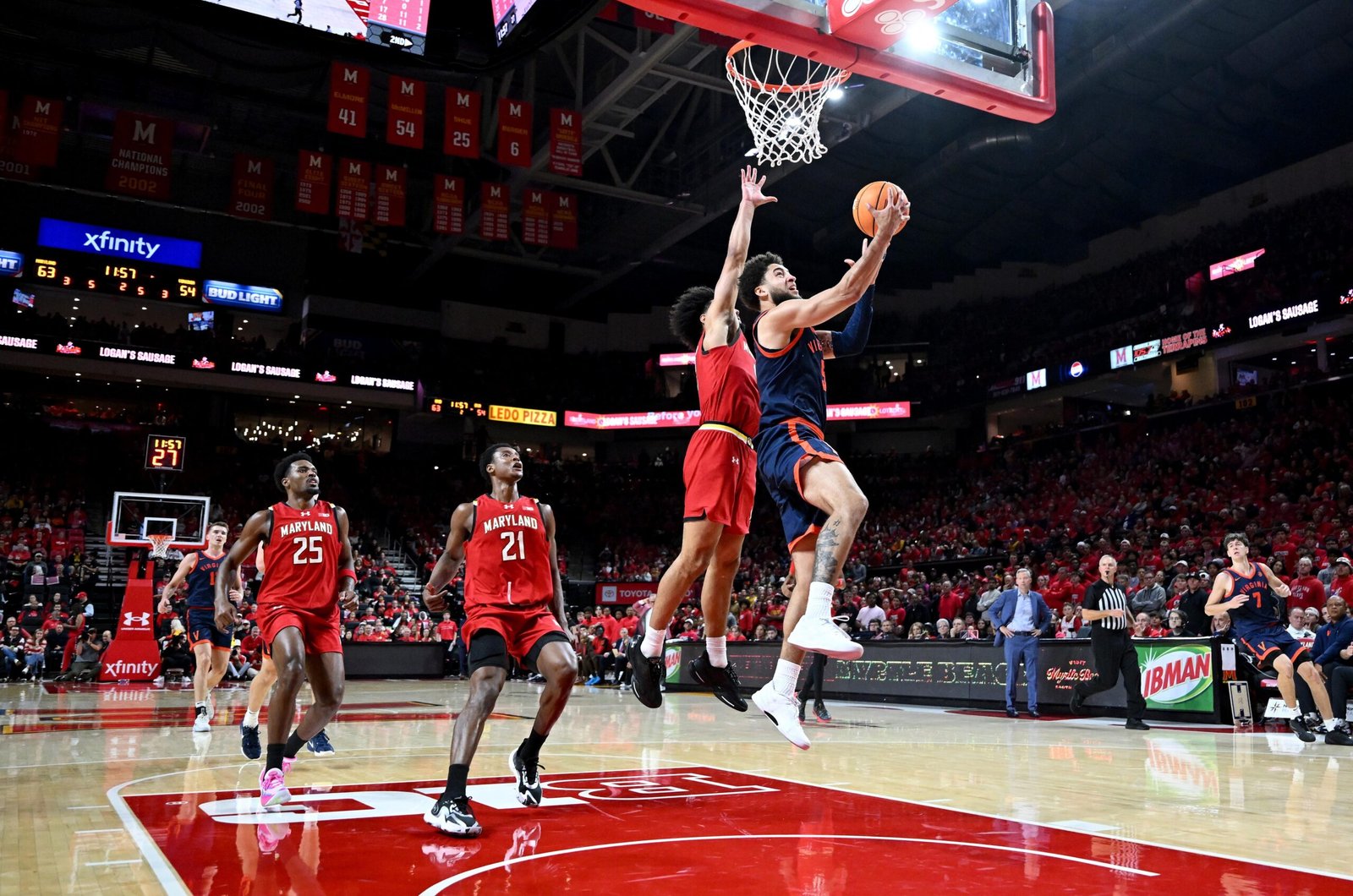
Lewis scored 28 points on 12-of-16 shooting, adding seven rebounds, a block and a perfect 4-of-4 from the line. His previous career high was 23, which he scored twice at Toledo in 2024-25 and matched against NC State last January. The 12 made field goals are also a career high.
He was the engine of the comeback. Lewis had 11 of Virginia’s first 21 points and kept attacking when the rest of the offense stalled. In the second half, he scored on a spin move, finished an and-one reverse layup off a De Ridder screen, blocked a shot on the other end and scored the go-ahead layup after Maryland had retaken the lead. The career high came on a drive that put his defender on the floor and ended with a slam. He was unstoppable all night when driving to the rim, making contested finish after contested finish.
However, it was not all sunshine and rainbows. Lewis also had seven turnovers, three of them in the first eight minutes, and two more in the closing minutes when Virginia was trying to finish it off. On one, he drove and tried to pass back out to the perimeter. In that situation, I would rather see the ball in Mallory’s hands. Lewis had six turnovers against Northeastern, too. He is at his best when he is going downhill, but he has to be more careful with the ball when the defense collapses on him. His ball handling and defense have, at times, drawn the ire of Virginia fans, and they are definite areas of weakness.
Still, that should not diminish the clinic he put on offensively. He was invaluable to Virginia’s comeback effort.
Turnovers and fouls almost doomed the ‘Hoos
Virginia turned the ball over 17 times, its most this season (its previous high was 14), and Maryland scored 24 points off them. Virginia came into the game averaging 13.3 steals and had at least 10 in all four games. On Friday, it had just five, while Maryland had 10.
Not all of that was Maryland’s defense. Many of the turnovers were self-inflicted: passes thrown into traffic, a travel down low, a ball dribbled off a foot. Ball security and turnover margin had been strengths through four games, and Friday they were not.
The fouling was worse. Virginia was called for 27 fouls, and Maryland went 31-of-39 at the line to Virginia’s 17-of-27, a 14-point edge in made free throws. Nolan Adekunle and Mallory both fouled out, and Kalu Anya picked up four fouls in only nine minutes. Adekunle’s foul trouble held him to 19 minutes and no points.
I thought the whistle was soft at times, especially in the first half, when Maryland shot 24 free throws to Virginia’s 14 despite being called for just one fewer foul. But a lot of the damage was Virginia’s own doing: a foul on a three-point shooter, fouls from behind on rebounds, reaching on the press. The free-throw disparity evened out in the second half (15 attempts to 13), and that is a big part of why Virginia was able to come back.
Against a Maryland team that went 4-of-17 from three, Virginia should not have needed a comeback. Seventeen turnovers and 39 opponent free throws will be Virginia’s kryptonite in big games if it cannot clean them up.
Virginia’s defense wore Maryland down despite a rowdy crowd
The Xfinity Center was loud from the opening tip. Maryland handed out “Crush the Cavs” shirts, and the crowd was into every whistle. Despite my Virginia biases, I will admit it was a very rowdy environment, and it gave Maryland a massive boost in the first half.
But Virginia’s defense ground the Terrapins down. Maryland shot 46 percent with seven offensive rebounds and three turnovers in the first half. In the second half, it shot 38 percent, grabbed just three offensive rebounds and turned it over seven times. Andre Mills went 2-of-13 from the field and 0-of-4 from three, and Maryland finished 4-of-17 from deep. Late in the game, Grünloh blocked a shot with straight-up defense (something the soft whistle had made hard to do all game), Virginia forced a travel and De Ridder came up with a steal, and fans were headed for the exits before the final horn.
To be fair, the second-half improvement was as much about Virginia’s offense and its fouling as its defense. Maryland made 11 field goals in the second half after making 13 in the first, and much of its first-half lead came at the free-throw line. The full-court press was not effective in generating turnovers for most of the night, but the effort did not drop off in the second half despite heavy minute loads, and it clearly wore on the Maryland players.
The core four is the backbone of this team
When it mattered, Ryan Odom leaned on his four best players. De Ridder played 32 minutes, Lewis 34, Mallory 35 and Grünloh 37. That is 138 of 200 minutes, and the four of them scored 75 of Virginia’s 87 points.
Grünloh’s 37 minutes are a career high, two more than the 35 he played in a triple-overtime game at Virginia Tech last season and against Arkansas last Sunday. After Arkansas, I wrote that he would not play 35 minutes every night and should not have to. Thirty-seven is a lot for a 7-footer, especially one who was limited by an ankle injury a week ago. That said, he made the most of it, with 15 points, seven rebounds and three blocks, and he went 7-of-11 at the line. De Ridder added 20 points on 8-of-13 shooting and seven rebounds, and Mallory had 12 points, five rebounds and four assists before fouling out in the closing seconds.
The bench picture is clear, too. Elijah Gertrude (19 minutes), Martin Carrere (10) and Anya (nine) are the rotation off the bench, with spot minutes for Jan Vide (three) and Jurian Dixon (one).
Personally, I would have loved to see Vide and Dixon get a bit more run out there, but I understand that Odom wants to stick with his guys.
It is clear that other players like Christian Harmon, Silas Barksdale and Favour Ibe are not currently in the rotation, despite Ibe’s four-block game against Bucknell. Of those three, Ibe is the only one who, in my opinion, has a potential path to playing time, but with Grünloh playing such heavy minutes, I do not really see that happening in the big games.
In all, that meant that Virginia’s bench scored 12 points to Maryland’s 42. That is fine in close games against good teams, but it puts a lot of weight on four players. Foul trouble and fatigue over the course of a grueling season are a significant risk.
Bonus: Free-throw shooting is an area for improvement
Virginia went 17-of-27 at the line (63 percent), including 8-of-13 in the second half. Through five games, it is shooting 70.9 percent, below last season’s 72.8 percent. Grünloh made seven, but the misses added up: Gertrude went 2-of-4 in the final minute, Mallory 2-of-4 and Anya missed the free throw on an and-one. If Virginia had simply shot better from the line, the game would have been significantly more comfortable.
Bonus: A tired team found a way
Virginia was playing its fifth game in 11 days, and it looked it. The legs were not there early, the turnovers piled up and the two missed dunks late looked like a slight loss in concentration that can certainly be attributed to fatigue. In contrast, Maryland came in with five days off and was clearly chomping at the bit for this game. Winning anyway says a lot about this group. Thankfully, Virginia now gets a few days to rest and two more home games against mid-major competition before the Battle 4 Atlantis.
What’s next
Virginia returns to John Paul Jones Arena on Tuesday to host Old Dominion at 9 p.m. on ACC Network, then hosts Loyola Maryland on Friday. After that, the Cavaliers head to the Bahamas for the Battle 4 Atlantis, opening against Marquette on Nov. 25.
With No. 2 Duke and No. 3 Illinois both losing Tuesday, a road win over a Big Ten team could help Virginia climb in Monday’s poll. More importantly, it showed this team can win when it does not play its best.
https://sports.yahoo.com/articles/five-takeaways-uva-basketball-87-042638923.html