By
Pakistan State Oil has signed a petroleum supply agreement with Oman’s OQ Trading, backed by a $200 million credit facility, as Islamabad moves to make fuel imports more reliable and less exposed to volatile regional energy markets.
By The BNN Media
The Best News Network
News Beyond the Borders
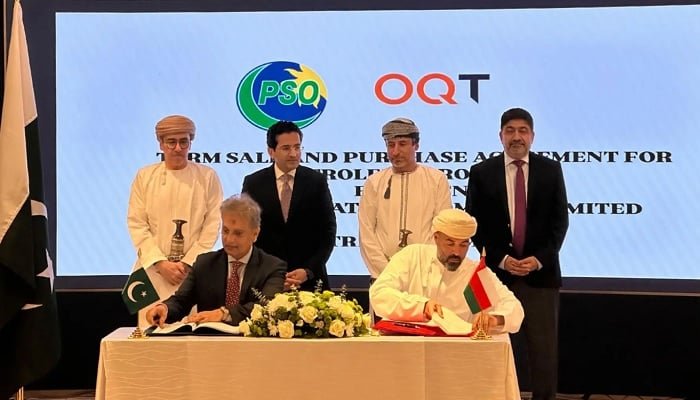
Muscat, Oman — Pakistan and Oman signed a sale and purchase agreement on Sunday, 22 November 2026, under which Oman’s OQ Trading will supply petroleum products to Pakistan State Oil (PSO) and extend a $200 million credit facility to finance the purchases. The deal was signed in Muscat in the presence of Pakistan’s Federal Minister for Petroleum, Ali Pervaiz Malik, and Oman’s Minister of Energy and Minerals, Eng. Salim Al Aufi.
A Structured Deal, Not a One-Off Shipment
The agreement sets up a formal, standing commercial framework for petroleum supplies from OQ Trading to PSO, rather than a series of ad-hoc purchases. According to Pakistan’s Petroleum Division, the arrangement is expected to improve procurement flexibility and supply reliability at a time when regional energy markets remain volatile.
The deal had been approved earlier by the Economic Coordination Committee (ECC) under an existing inter-governmental agreement between Pakistan and Oman. Officials say it is aimed at strengthening bilateral energy cooperation and diversifying Pakistan’s sources of petroleum imports.
The takeaway is straightforward: Pakistan is buying predictability as much as it is buying fuel.
What the $200 Million Credit Line Does
The centrepiece of the agreement is the credit facility itself. OQ Trading has agreed to provide PSO with a credit limit of $200 million to finance its petroleum purchases, giving the state-owned company more room to manage the timing and cost of imports.
For a country that imports almost all of its petroleum, that flexibility matters. Fuel purchases are large, frequent and priced in foreign currency, so the ability to buy on credit terms can ease short-term pressure on cash flow and help keep supplies flowing when markets turn choppy.
- The credit limit is $200 million, extended by OQ Trading to PSO.
- It covers purchases of petroleum products under the new sale and purchase agreement.
- The Petroleum Division says it will give PSO additional financial flexibility in meeting import requirements.
Credit on this scale does not remove the import bill, but it does give Pakistan more breathing room in paying it.
A Relationship That Was Already Growing
The new agreement builds on a commercial relationship that had already become significant during 2026. OQ Trading has emerged as a major gasoline supplier to PSO, delivering more than one million tonnes of gasoline during the year, according to the Petroleum Division.
Oman’s trading arm has also expanded its presence in Pakistan’s liquefied petroleum gas (LPG) market, supplying both state-owned and private-sector buyers. Its LPG supplies to Pakistan are expected to exceed 120,000 metric tonnes by the end of 2026, reflecting Oman’s growing role in meeting the country’s energy needs.
The formal agreement now puts that expanding trade on a structured footing, with agreed terms for regular supplies instead of deals arranged shipment by shipment.

Why Diversification Matters Now
Pakistan’s fuel supply depends heavily on a small number of Gulf suppliers and on shipping routes that pass through some of the world’s most sensitive waters. When regional energy markets turn volatile, that dependence can quickly translate into supply worries and price pressure at home.
The Petroleum Division framed the Oman agreement in exactly those terms, saying it would support supply reliability amid continued volatility in regional energy markets and help Pakistan diversify its import sources. The ministers who witnessed the signing expressed confidence that implementing the agreement would strengthen Pakistan-Oman energy ties and support Islamabad’s efforts to enhance energy security through diversification.
Diversifying suppliers is a slow, practical form of insurance — and this deal is one more step in that direction.
Beyond Fuel: A Joint Working Group on Oil and Gas
The signing came after a meeting between Malik and Al Aufi in Muscat, where the two ministers explored ways to strengthen bilateral cooperation in the oil, gas and minerals sectors. The discussions also covered new investment opportunities and expanding commercial partnerships across the energy and minerals value chain.
Both sides welcomed the establishment of a Pakistan-Oman Joint Working Group on Oil and Gas, and agreed to make effective use of the institutional mechanism to deepen bilateral engagement and advance cooperation in the energy and mining sectors.
The working group gives the two countries a standing forum to coordinate on supplies, contracts and future investment, rather than relying on ministerial visits alone to move things forward.

What to Watch Next
The agreement’s value will be judged in the months ahead, not on the day of the signing. The questions that matter now are practical ones: whether supplies under the new framework arrive on schedule, whether the credit line is used smoothly, and whether the joint working group produces further deals in oil, gas and minerals.
For consumers, the most immediate hope is simpler — that steadier, better-financed fuel imports help keep petrol stations supplied and reduce the risk of the shortages and queues that have hit Pakistani motorists in the past.
If the framework works as described, Pakistan will have turned a longstanding friendship with Oman into a more reliable fuel lifeline.
Sources
- The News, “$200m Oman credit facility for fuel imports secured”, 23 November 2026 — https://www.thenews.pk/print/1450365-200m-oman-credit-facility-for-fuel-imports-secured
- Energy Update, “Pakistan, Oman Sign Petroleum Supply Deal with $200m Credit Facility for PSO”, 23 November 2026 — https://www.energyupdate.com.pk/pakistan-oman-sign-petroleum-supply-deal-with-200m-credit-facility-for-pso/
By The BNN Media
The Best News Network
News Beyond the Borders