 By
Last Updated:
India’s five largest quick-commerce networks span 470+ cities, creating frontline jobs. Can dark stores keep deliveries fast, reliable and meet rising customer expectations?




Mobile phones and lifestyle products accounted for around 51% of festive e-commerce sales, while grocery, appliances and personal care gained share.
India’s festive shopping season is no longer confined to crowded markets, shopping malls or online sales that arrive a few days later. Consumers are moving between e-commerce platforms, quick commerce apps, neighbourhood stores and malls, choosing where to shop based on price, convenience and how quickly they need a product.
But this changing shopping behaviour is putting pressure on the infrastructure supporting India’s retail boom. Behind every festive order are warehouses, dark stores, inventory teams, retail associates and delivery workers trying to keep products available and reach customers on time.
The scale of the opportunity is significant. Festive e-commerce sales crossed Rs 1.2 lakh crore in 2025, growing around 27% year-on-year, according to the Festive Barometer by Datum Intelligence. Quick commerce also increased its share of festive spending from 8% in 2024 to 12% in 2025.
Meanwhile, TeamLease Services expects temporary festive hiring across organised retail, e-commerce, quick commerce, logistics, FMCG and consumer durables to rise 15-20% in 2026. The shift raises a bigger question: is India’s retail ecosystem expanding fast enough to meet consumers’ growing expectations?
The New Festive Shopping Habit
Festive shopping is becoming an omnichannel experience. Consumers may compare prices on an online marketplace, visit a mall to check a product, buy groceries from a neighbourhood store and turn to a quick-commerce app for something they need immediately.
The festive basket is also changing. Quick commerce is expanding beyond groceries into categories such as beauty, fashion, gifting and home décor. E-commerce platforms continue to offer discounts and product variety, while physical stores provide the opportunity to see and experience products before buying.
The 2025 festive data reflects this diversification. Mobile phones and lifestyle products accounted for around 51% of festive e-commerce sales, while grocery, appliances and personal care gained share.
The shift is not simply about buying more online. It is about consumers expecting different channels to work together. For retailers, that means managing inventory, customer service and fulfilment across multiple points of purchase, often during the same peak period.
“Consumers now choose a channel by the occasion rather than sticking to one. Quick commerce wins on speed, marketplaces on choice, malls on experience and local shops on trust. Convenience is now as important as price: quick commerce’s share of festive spend rose from 8% to 12% last festive season. A recent Grant Thornton survey found over 70% of consumers would keep using quick commerce even with smaller discounts. With retail and e-commerce both leading hiring intent, the growth is showing up across online and offline channels together,” said Balasubramanian A, Senior Vice President, TeamLease Services.
What Happens Behind The 10-Minute Delivery Promise?
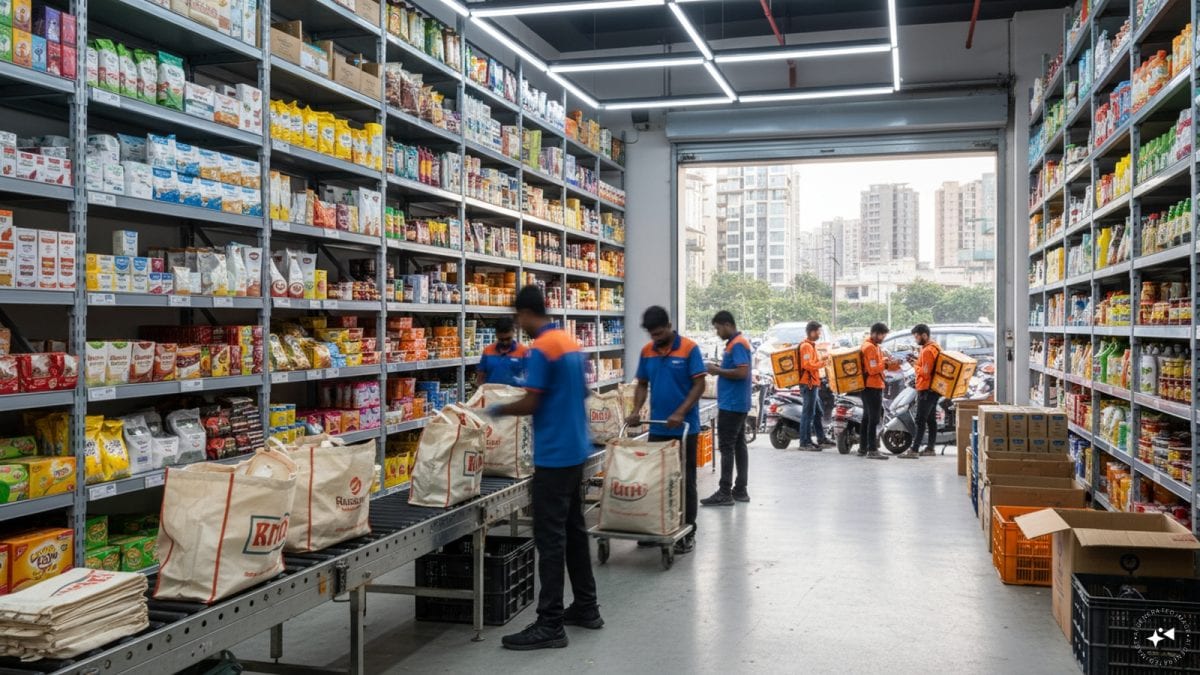
The promise of rapid delivery depends on a network customers rarely see. Quick-commerce companies rely on dark stores, local inventory, warehouse workers, order pickers, packers and delivery personnel to fulfil orders within short windows.
The process begins well before a customer places an order. Products must be stocked in the right locations, inventory updated accurately and replenishment planned around demand. Once an order arrives, workers need to pick and pack it quickly before a delivery partner takes it to the customer.
During festive periods, the challenge becomes more complicated. Demand can rise sharply for groceries, gifts, beauty products, fashion and electronics. A product may appear available on an app but be out of stock at the nearest fulfilment centre. Delays can also occur when several orders arrive together or delivery capacity falls short.
The infrastructure behind quick commerce therefore involves more than adding delivery workers. Companies need to anticipate demand, distribute stock across locations and ensure warehouse and delivery operations can handle sudden spikes.
“The 10-minute promise is won long before the order is placed. Upstream warehouses forecast demand and push stock into dark stores, and inside those stores the clock is set by pick-and-pack speed, accurate inventory and quick replenishment. That network is now large: India’s five largest quick commerce networks run roughly over 7,000 dark stores and micro-fulfilment centres, spread across 470+ cities. This is creating new roles such as dark store associates, inventory and fulfilment coordinators and quality check executives, alongside pickers and packers who must handle perishables, scanners and handheld devices. Talent supply is not as much as a constraint as readiness is, which is why digital skills matter and why roles like warehouse operations executives and dark store supervisors are in demand,” said Balasubramanian.
Festive Hiring Is Growing, But Workforce Readiness Is Crucial
The changing retail landscape is also reshaping festive employment. TeamLease Services’ Festive Season Workforce Report 2026 expects temporary hiring to increase by 15-20% across organised retail, e-commerce, quick commerce, logistics, FMCG and consumer durables.
However, hiring is shifting beyond simply adding numbers. Businesses need workers who can manage specialised frontline roles, including warehouse pickers, packers, dark-store staff, retail associates, inventory coordinators and returns management executives.
The sales calendar is also getting longer. Festive promotions now stretch from Independence Day through Diwali and into the year-end holiday season. Businesses need workers who can support sustained demand rather than only a short Diwali rush.
That makes training and deployment crucial. Employers must ensure that new workers can use digital systems, manage inventory and maintain service quality while working under pressure.
“Faster delivery has improved convenience, and the next step is making it consistently reliable. Speed now comes from store proximity, while quality depends on what happens inside the dark store. The recent food safety inspections of dark stores are a healthy push in that direction, and FSSAI is planning to amend regulations so consumers know the manufacturing date, expiry date and batch number of products they order. As the sector matures, competition will shift to accuracy, freshness and hygiene, and trained, process-driven frontline teams will help turn speed into trusted service,” said Balasubramanian.
Where Is The Demand Shifting?
Large consumption centres such as Delhi NCR, Mumbai, Bengaluru and Hyderabad remain important hiring hubs. TeamLease expects Tier-1 cities to account for 40.5% of the festive frontline workforce in 2026, compared with 38.2% in 2025. Tier-2 cities are projected to contribute 26.5%, while Tier-3 markets are expected to account for 33%.
The figures suggest that festive retail employment remains concentrated in larger urban centres, even as businesses expand beyond metros.
“Metros are where consumption density, digital adoption and enterprise investment come together, so they are absorbing a growing share of new jobs,” Balasubramanian pointed out. “Employers expanding their workforce this half (in the second half) name Bengaluru (68%), Hyderabad (61%), Mumbai (55%) and Delhi (53%) among their top target locations, driven by tech, GCCs, BFSI and consumer businesses. On the frontline, quick commerce is adding to this pull: Tier I cities are expected to account for 40.5% of the festive frontline workforce in 2026, up from 33.1% in 2024, as dark stores and hyperlocal hubs concentrate where order density makes fast delivery viable. Bengaluru is now the largest single dark store market, with 700+ stores. At the same time, Tier II and III cities are rising as consumption engines, so metros will anchor hiring while growth increasingly spreads outward.”
The expansion of retail and fulfilment networks also creates demand for people who can manage stock, process orders and handle customer-facing roles. Smaller cities are increasingly part of this wider retail ecosystem, although the scale and nature of operations vary by location.
Is India Building A Year-Round Instant Retail Ecosystem?
The latest hiring projections suggest that festive demand is changing how businesses prepare for the season. Rather than treating the rush as a short-term staffing problem, retailers and delivery companies are building teams for longer sales windows and more complex fulfilment requirements.
So, can India’s retail infrastructure keep pace with consumers who increasingly expect products to be available whenever and wherever they shop? That requires investment in inventory planning, warehouses, technology, workforce training and last-mile delivery.
“It is more structural than seasonal. The festive season has itself become a marathon, and quick commerce demand stays strong beyond it. According to Redseer, orders averaged about 7.8 million a day in January 2026, up around 95% year on year. Hiring intent reflects this too, with e-commerce (12.6%) and retail (10.3%) leading the employment outlook for HY2 of FY27. Festive peaks will still drive temporary hiring, but dark store, fulfilment and inventory roles are increasingly becoming year-round jobs.”
Festive sales may bring the sharpest test, but the expectations they create do not disappear after Diwali. As consumers continue to move between online platforms, quick commerce, malls and neighbourhood stores, the retail ecosystem should deliver convenience without compromising availability or service.
Quick Answers
 Ask News18
Bengaluru has emerged as the largest single dark store market, featuring over 700 stores and a dark store density nearly three times the national average, with about 153 sq ft of space per 1,000 residents.
Ask News18About the Author

Shilpy Bisht is a News Editor at News18, where she leads the English app operations. She writes on world affairs, health, AI, career, business, and issues affecting women and children. A former print …Read More
November 10, 2026, 17:14 IST

Stay Ahead, Read Faster
Scan the QR code to download the News18 app and enjoy a seamless news experience anytime, anywhere.