By
After eight years, nine planetary flybys and a journey of some 10 billion kilometres, the joint European-Japanese BepiColombo mission is due to be captured into orbit around Mercury on Saturday, 21 November 2026 — the start of a six-month arrival that will put two spacecraft around the Sun’s closest planet at the same time.
By The BNN Media
The Best News Network
News Beyond the Borders
Darmstadt, Germany — The BepiColombo spacecraft is due to be captured into orbit around Mercury on Saturday, 21 November 2026, the European Space Agency (ESA) has said, bringing to an end an eight-year journey that began with a launch from French Guiana on 20 October 2018 and took the mission on a winding, 10-billion-kilometre route through the inner Solar System.
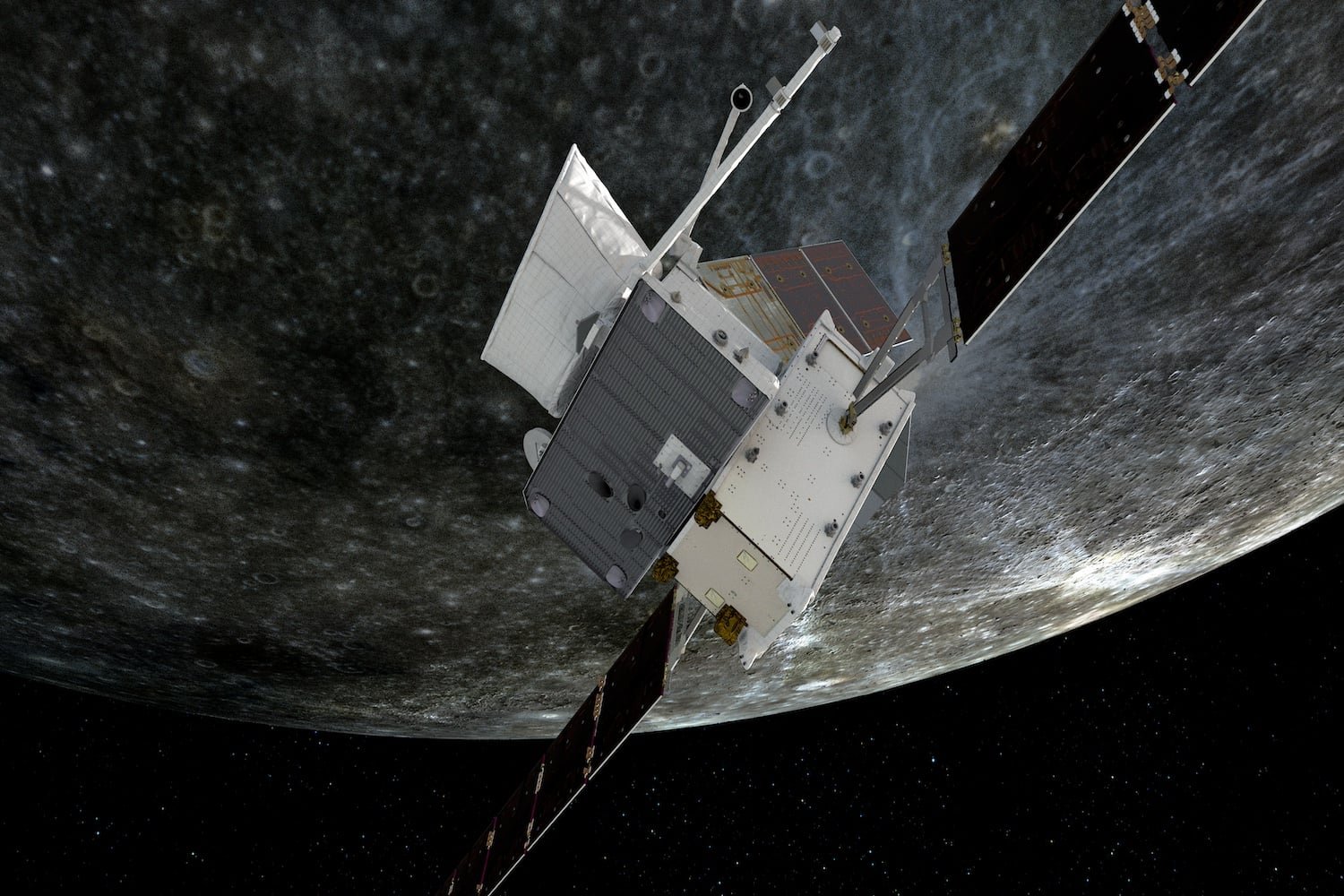
BepiColombo is a joint mission of ESA and the Japan Aerospace Exploration Agency (JAXA), and it will be the first mission ever to place two spacecraft in orbit around Mercury at the same time: ESA’s Mercury Planetary Orbiter (MPO) and JAXA’s Mercury Magnetospheric Orbiter, known as Mio. The two orbiters are still joined together for the capture, and they will separate in December to take up their own orbits around the planet. Science operations are planned to begin in April 2027.
Why Getting to Mercury Is So Hard
Reaching Mercury is one of the hardest journeys in spaceflight. The planet sits close to the Sun, and a spacecraft falling towards the Sun keeps speeding up — so to be captured by Mercury’s weak gravity, BepiColombo had to shed most of that speed. Flying there directly would take more change in velocity than reaching Pluto.
BepiColombo did its braking in two ways: long, low-thrust burns of its solar-electric (ion) thrusters, and gravity assists from planetary flybys. Instead of flying straight to Mercury, it passed Earth once, Venus twice and Mercury itself six times — nine flybys in all — each one shrinking its orbit a little more. The last electric-propulsion thrust arc ended on 15 June 2026, and the transfer module that carried the spacecraft through the cruise was cast off on 3 September 2026.
“For a long time, people didn’t think it was possible to get to Mercury orbit,” Shoshana Weider, Mercury science lead at NASA Headquarters, told Scientific American.
Mercury is the hardest planet in the Solar System to reach — and BepiColombo spent eight years slowing down to get there.
A Gentle Capture, Not One Big Burn
Saturday’s arrival will not be a single dramatic engine burn. ESA plans to use a technique called weak stability boundary capture, in which the spacecraft drifts into Mercury’s sphere of influence and needs only a small manoeuvre by MPO’s chemical thrusters, at its closest point to the planet, to be captured into polar orbit.
The capture is only the beginning of the arrival. According to Space.com, it opens a sequence of 16 manoeuvres lasting about six months that will gradually shrink and reshape the orbit, rather than one pass-or-fail moment. ESA says the exact dates can change for operational reasons, and it has published no clock time for the capture.
The planned milestones after Saturday are:
- 9–10 December 2026 — MPO and Mio separate; Mio settles into its own elliptical polar orbit
- 16 December 2026 — MPO releases Mio’s sunshield (MOSIF) and descends towards its own orbit
- 10 March 2027 — MPO reaches its final science orbit
- 6 April 2027 — science operations begin
The separation in December will be one of the most delicate moments of the mission. Latches will unclasp, wires connecting the two spacecraft will be cut, and a spring will push them apart slower than walking speed — while both are orbiting another world.
Saturday is not the end of the journey — it is the first step of a six-month arrival.
A Year Late, After a Thruster Fault
BepiColombo was originally meant to arrive at Mercury in December 2025. In April 2024, engineers found that the spacecraft’s electric propulsion could not run at full power, after unexpected currents were found between the solar array and the power unit. ESA recalculated the route around the weaker thrust, and the arrival moved back by about a year, to November 2026.
The delay also pushed the mission past the point where its own final Mercury flyby, on 8 January 2025, gave scientists their closest look yet at the planet’s cratered northern hemisphere. That flyby completed the set of six Mercury encounters that had bled away the spacecraft’s speed.
The mission is named for Giuseppe “Bepi” Colombo, the Italian mathematician and engineer who worked out how to reach Mercury orbit using gravity assists, and who died in 1984. NASA’s MESSENGER spacecraft, which entered Mercury orbit in March 2011, remains the only mission to have orbited the planet before BepiColombo.
Two Orbiters, Two Very Different Jobs
Once separated, the two orbiters will work as a pair, each studying a different part of Mercury. MPO will fly a close orbit of 480 by 1,500 kilometres above the surface, completing one orbit in about 2.3 hours, carrying 11 scientific instruments. Mio will fly a much wider orbit of 590 by 11,640 kilometres, taking about 9.3 hours per orbit, with five instrument groups studying Mercury’s magnetic field and the plasma around it.
Together, the two spacecraft will tackle questions that have puzzled scientists for decades:
- Why does Mercury have a magnetic field? Mercury is the smallest planet and the closest to the Sun — and the only rocky planet besides Earth with a magnetic field generated inside itself. BepiColombo will probe how that field is made and sustained.
- Why is there ice on a scorched planet? The floors of craters near Mercury’s poles are permanently shadowed and bitterly cold, and radar observations suggest water ice may hide there. BepiColombo’s instruments will hunt for it.
- What is Mercury made of? The mission will map the planet’s surface, interior and composition, and study its thin exosphere — the faint wisp of gas around it — to understand how a planet so close to its star formed and evolved.
- Does Einstein still hold? Instruments on board will test the theory of general relativity by measuring Mercury’s orbit and gravity field with high precision.
The two orbiters are expected to observe Mercury together for at least one year, with a possible one-year extension, before their orbits decay and they eventually crash into the planet.
Two spacecraft, two orbits, one planet — BepiColombo is designed to see Mercury in a way no single orbiter ever could.
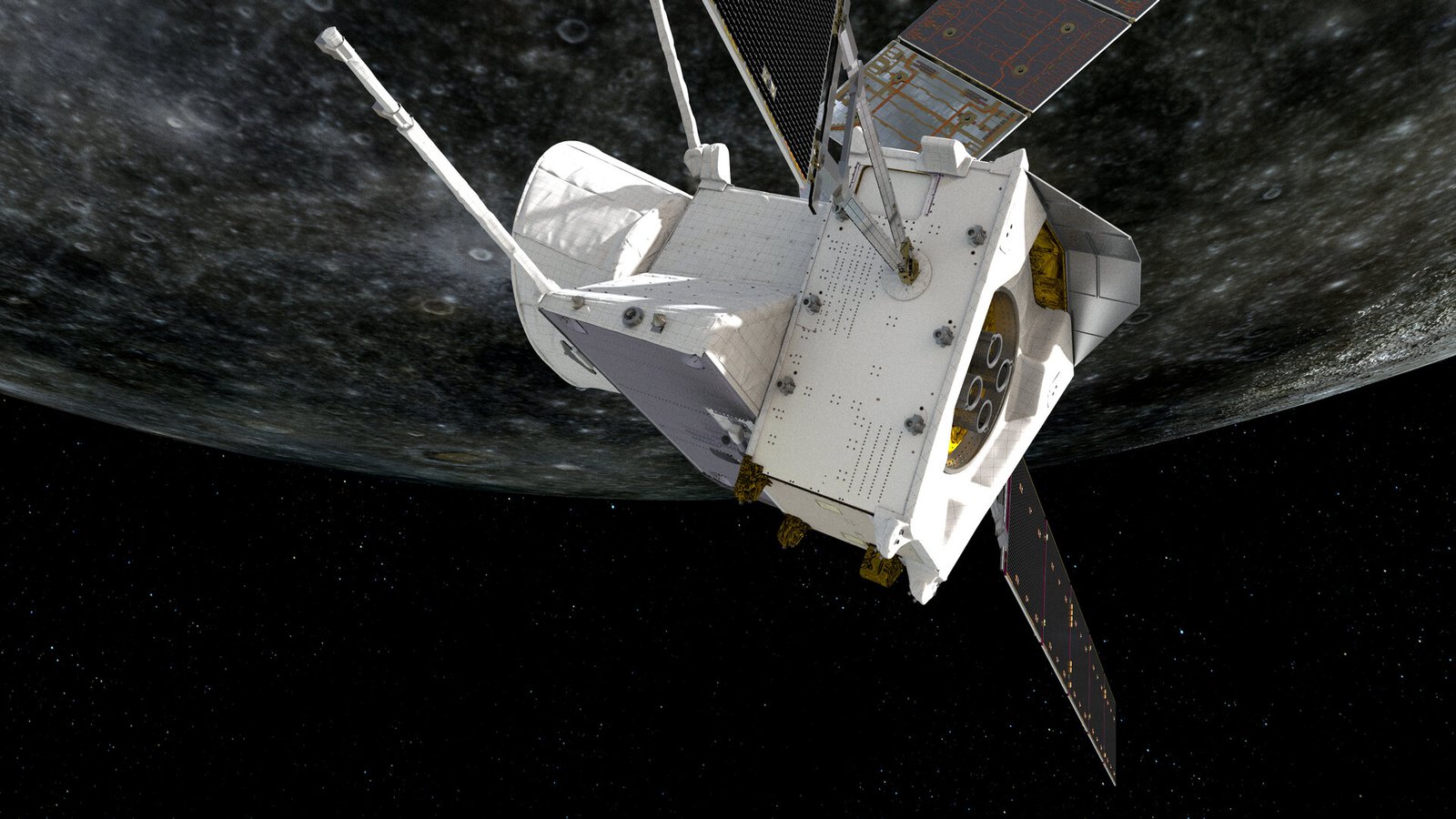
A Planet Worth the Wait
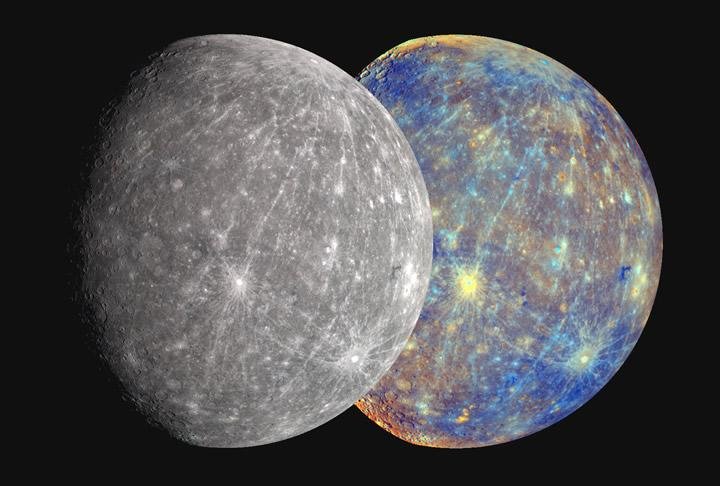
Mercury is the least explored planet of the inner Solar System, and the most extreme: a small desert world of craters and cliffs, where the surface is slowly shrinking as the planet cools, forming vast escarpments kilometres high — and where, scientists say, some of those thrust faults are still moving. Its magnetosphere is the most compressed of any planet, squeezed by the solar wind so tightly that charged particles can reach the surface directly.
As a coincidence of timing, Mercury reaches its greatest western elongation — its farthest apparent distance from the Sun in the morning sky — on 20 November 2026, the day before BepiColombo’s arrival, giving sky-watchers a chance to spot the planet the mission is about to join.
BepiColombo’s arrival is also a reminder of how far deep-space exploration has come. Where once a single probe was an achievement, missions now fly in pairs — and humanity’s farthest-flung explorer, Voyager 1, has crossed a distance of one light-day from Earth, a scale no human-made object had reached before. BepiColombo’s destination is far closer to home, but the journey to get there was, in its own way, just as demanding.
If Saturday’s capture goes as planned, the eight-year cruise will be over — and the science, the reason for the whole mission, will finally be about to begin.
Eight years, nine flybys, 10 billion kilometres — and on Saturday, BepiColombo finally arrives.
By The BNN Media
The Best News Network
News Beyond the Borders
Sources: European Space Agency (esa.int), 2026; Scientific American, 20 November 2026; Space.com (via Tech Times), 19 November 2026; KeepTrack, November 2026; ESA Science & Technology (sci.esa.int).