 By
Last Updated:
While some experts see this as a check on fraud and undue procedures in private hospitals under PM-JAY, others warn that government facilities may not be equipped to handle flow




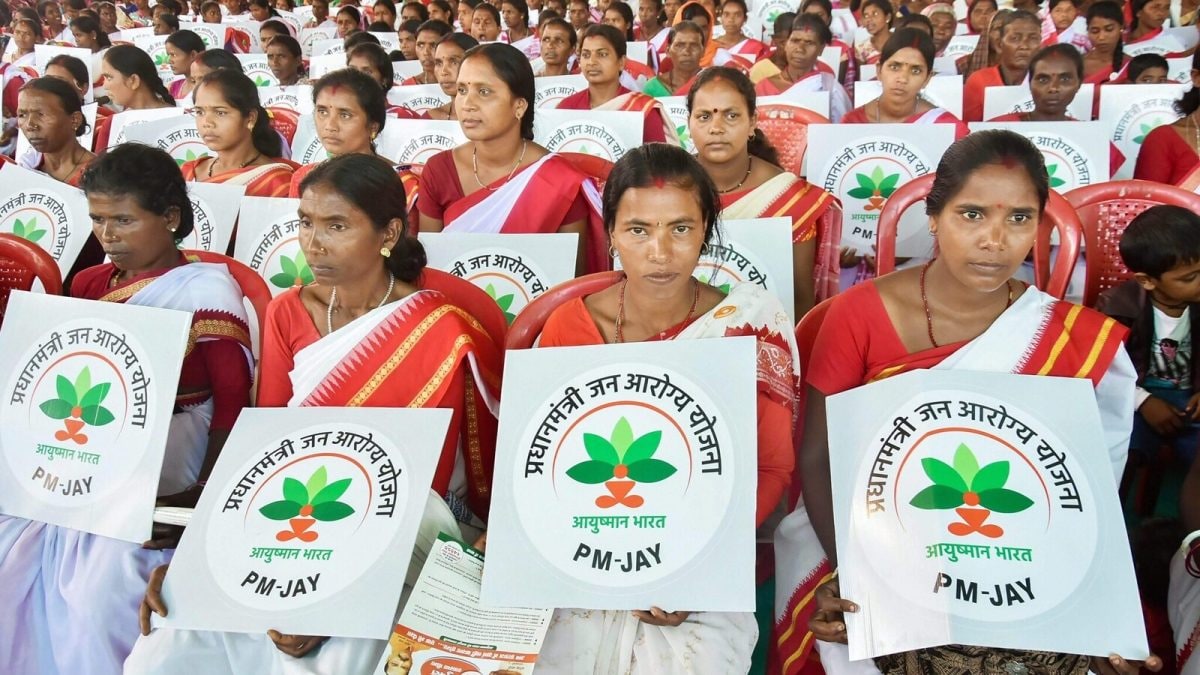
PM-JAY gives eligible families cover of up to Rs 5 lakh a year, and it was set up to protect poor families from unaffordable spending on health emergencies. Representational image/PTI
Ayushman Bharat beneficiaries may soon have to go to a government hospital for a C-section, kidney stone pain, a urinary tract infection, diarrhoea, malaria or piles surgery, or pay for the treatment themselves at a private hospital, News18 has learnt. The Centre has proposed reserving 112 procedures under the scheme exclusively for public hospitals.
The list also includes assisted vaginal deliveries, high-risk deliveries, hysterectomies, abortions, hepatitis, pancreatitis, severe anaemia, and biopsies and cervical screening used to check for cancer, according to an official document from the National Health Authority (NHA) accessed by News18.
The NHA, which runs the Ayushman Bharat Pradhan Mantri Jan Arogya Yojana (AB PM-JAY), has proposed expanding the list of procedures reserved for public hospitals from 23 to 112. States have been asked to submit suggestions by November 25, and implementation is planned to begin on December 1.
Experts are divided on the move. Some see it as a check on fraud and unnecessary procedures in private hospitals under PM-JAY. Others warn that government facilities may not have the capacity, especially in states with weaker health systems, and that restricting emergency care could leave patients worse off.
What has been proposed?
The Centre has proposed taking an additional 89 procedures out of the scheme’s cover at private hospitals.
The NHA has proposed adding the 89 procedures to the 23 already “reserved” for public facilities. The official document, dated October 13, has been sent to the chief executive officers of state health agencies. The list includes four types of hysterectomy, abortion at all stages, emergency admissions for malaria, severe anaemia and a dangerous spike in blood pressure, and care for children with Attention-deficit/hyperactivity disorder (ADHD).
At A Glance
The National Health Authority has proposed expanding the number of medical procedures reserved exclusively for public hospitals from 23 to 112 under the Ayushman Bharat scheme.
The newly proposed restricted procedures include C-sections, hysterectomies, biopsies, cervical screenings, and emergency treatments for malaria and severe anaemia.
States have been asked to submit suggestions on the proposal by November 25, with implementation planned to begin on December 1.
Under the proposed changes, private hospitals can still perform these procedures, but they will no longer be able to claim payments for them under the PM-JAY scheme.
“Based upon the review of existing State-level reservation practices and the expected service delivery capacity of public health facilities, it is proposed to expand the existing national list of 23 reserved procedures to 112 procedures,” the document said.
States and union territories (UTs) have been asked to send suggestions by November 25. “Based on the suggestions received, it will be implemented in the transaction management system (TMS) wef 01st December 2026,” it added.
The office memorandum says many states have already reserved packages for public hospitals on their own, “particularly for services that are routinely available within the public health system”.
“However, the number and type of packages reserved vary considerably across States. Therefore, there is a need to consolidate these state-level practices and provide a more consistent national approach,” it said.
What does reservation mean for patients?
A reserved package can only be booked by public hospitals empanelled under the scheme. Private hospitals can still carry out these procedures, but they can’t claim payment for them under PM-JAY.
For a beneficiary, the choice becomes a government hospital for free, or a private hospital paying out of pocket. PM-JAY gives eligible families cover of up to Rs 5 lakh a year, and it was set up to protect poor families from unaffordable spending on health emergencies.
“The States/UTs may increase the packages to be reserved. However, any decrease can be done only with written approval by the respective State Government in the Health and Family Welfare Department,” the document said. So once it’s adopted, the 112-procedure list becomes the starting point everywhere.
Biopsies and cancer screening
The new list includes several procedures doctors use to find out whether a lump or abnormal growth is cancer. A biopsy is often the first and most important step.
Two are biopsy packages under general surgery – one covers lymph node biopsy, while the other covers endometrial aspiration, which takes a tissue sample from the lining of the uterus.
The list also includes diagnostic hysteroscopy “with biopsy” and “without biopsy”. In this procedure, a doctor looks inside the uterus with a thin camera. It also includes loop electrosurgical excision of the transformation zone (LLETZ), listed in the document as “LLETZ (including PAP smear and colposcopy)”. Pap smears and colposcopy are tests used to screen for cervical cancer.
Hysterectomy, abortion & emergency admissions
Obstetrics and gynaecology accounts for 21 of the 89 additions. Four are hysterectomy packages: vaginal, non-descent vaginal, abdominal and laparoscopically assisted vaginal hysterectomy. The current list already has abdominal, laparoscopic and caesarean hysterectomy. Together, that would leave almost every kind of uterus-removal surgery under the scheme for government hospitals.
Abdominal myomectomy, the surgical removal of fibroids, is also on the list. So is medical termination of pregnancy (MTP) up to eight weeks, at eight to 12 weeks and after 12 weeks.
Most of the 24 general medicine additions are conditions that bring patients to a hospital suddenly and need admission. Several can become life-threatening.
These include accelerated hypertension, a dangerous rise in blood pressure, as well as severe anaemia, acute flare-ups of chronic obstructive pulmonary disease (COPD) and gastroenteritis with severe or moderate dehydration. Also listed are recurrent vomiting with dehydration, malaria, chikungunya, acute febrile illness, pyrexia of unknown origin, acute viral hepatitis, renal colic, chronic pancreatitis, alcoholic liver disease, chronic hepatitis and diabetic foot.
What do experts think of the move?
According to Indranil Mukhopadhyay, public health economist and professor at OP Jindal Global University, there have been a lot of frauds under PM-JAY, with induced demand and unnecessary care. “Out of 100 deliveries, on average 10 to 15 should be caesarean sections. But under PM-JAY, C-sections increase to 45-60 per cent, and there are states with 70-80 per cent. Clearly, a lot of it is unnecessary.”
Mukhopadhyay told News18 that the same overuse is seen in procedures like knee replacement, hysterectomy and cataract. He added that another concern is whether the public sector has the capacity, and called for “a graded approach” that builds the public system gradually while trusting well-meaning private and non-profit hospitals.
KM Gopakumar, health laws researcher and co-convener of the Working Group on Access to Medicines and Treatment, which works closely alongside the public health network Jan Swasthya Abhiyan (JSA), believes “the move is ostensibly to expand the delivery capacity of public health facilities. However, the question comes whether the public health facilities are equipped to deliver on this front without additional investment in the expansion of infrastructure. It is important to ensure that public health facilities are equipped to provide these services without compromising the quality as well as on time.”
Similarly, economist Reetika Khera of the Indian Institute of Technology (IIT) Delhi explained, “Public health services vary considerably across states. Facilities that are common at a PHC in Kerala or Tamil Nadu may only be available at a district hospital in Bihar or Uttar Pradesh.”
Khera added, “If the list of procedures reserved for public health services is standardised across the country, it may affect access to healthcare adversely (in states with weaker facilities, patients will end up having to go to the district if private health care is no longer possible). Emergency/life-threatening procedures should also be kept open to both sectors for the same reason.”
Quick Answers
 Ask News18
The National Health Authority has proposed expanding the number of procedures reserved exclusively for public hospitals from 23 to 112. Under this plan, beneficiaries requiring treatments like C-sections, abortions, and kidney stone management would have to visit a government hospital for free care or pay out of pocket at private facilities.
Ask News18About the Author

Himani Chandna, Senior Associate Editor at CNN-News18, tracks healthcare, pharma and medical research, bringing clarity to complex science and policy.
November 18, 2026, 05:51 IST