 By
Last Updated:
From puris and seasonal vegetables to kheer and Chhappan Bhog, discover what is prepared for Govardhan Puja and the legend of Krishna lifting Govardhan Hill.




Govardhan Puja celebrates Lord Krishna’s legendary act of lifting Govardhan Hill, with Annakut — a mountain of food offerings — taking centre stage. From seasonal vegetables and puris to traditional sweets and the 56 offerings of Chhappan Bhog, here’s what makes the post-Diwali feast special.
The diyas may have been put away, the last of the Diwali sweets may be disappearing from the kitchen shelves, and the festive cleaning may finally be over. But in many Indian homes, the feasting is far from finished. Just when you think the festive menu has had its moment, Govardhan Puja arrives with an altogether different kind of spread.
Also known as Annakut, the festival is celebrated on the day after Diwali in many parts of India. In 2026, it falls on November 10. And while prayers and rituals form an important part of the occasion, food takes centre stage. Devotees prepare an elaborate spread of vegetarian dishes, sweets, savouries and dairy-based delicacies, offering them to Lord Krishna in a tradition that celebrates abundance, gratitude and the gifts of nature.
The word Annakut itself offers a clue to the occasion. It translates to a ‘mountain of food’ — an apt description of the generous spread that devotees prepare and arrange before the deity. But behind this feast is a story that goes back to Krishna’s childhood in the land of Braj.
The story behind Govardhan Puja: When Krishna lifted a hill
According to Hindu mythology, the people of Vrindavan once prepared elaborate offerings to worship Lord Indra, the god of rain. They believed that pleasing him would bring rainfall and ensure prosperity for their crops and cattle.
Young Krishna, however, questioned the practice. He encouraged the villagers to honour Govardhan Hill instead, pointing out that it was the land, its forests, pastures and natural resources that directly sustained their lives. The hill provided grazing grounds for cattle, supported agriculture and gave the community what it needed to survive.
The villagers followed Krishna’s advice and directed their offerings towards Govardhan Hill. Indra, angered by what he saw as an insult, unleashed torrential rain upon Vrindavan.
As the downpour grew fiercer, threatening people and cattle alike, Krishna lifted Govardhan Hill on his little finger. He held it aloft like an enormous umbrella, giving the villagers and their animals shelter beneath it. For seven days, Krishna is believed to have kept the hill raised until Indra finally recognised his mistake and brought the storm to an end.
The episode is remembered as Govardhan Leela. Its message goes beyond divine protection: it is also about humility, respect for nature and recognising the forces that sustain everyday life. The festival commemorates Krishna’s act by worshipping Govardhan Hill and celebrating the abundance it represents.
Why food becomes the centrepiece
The story of Govardhan is closely connected to the food traditions of the festival. If the hill symbolised the natural resources that nourished the villagers, the Annakut offering is a way of expressing gratitude for that abundance.
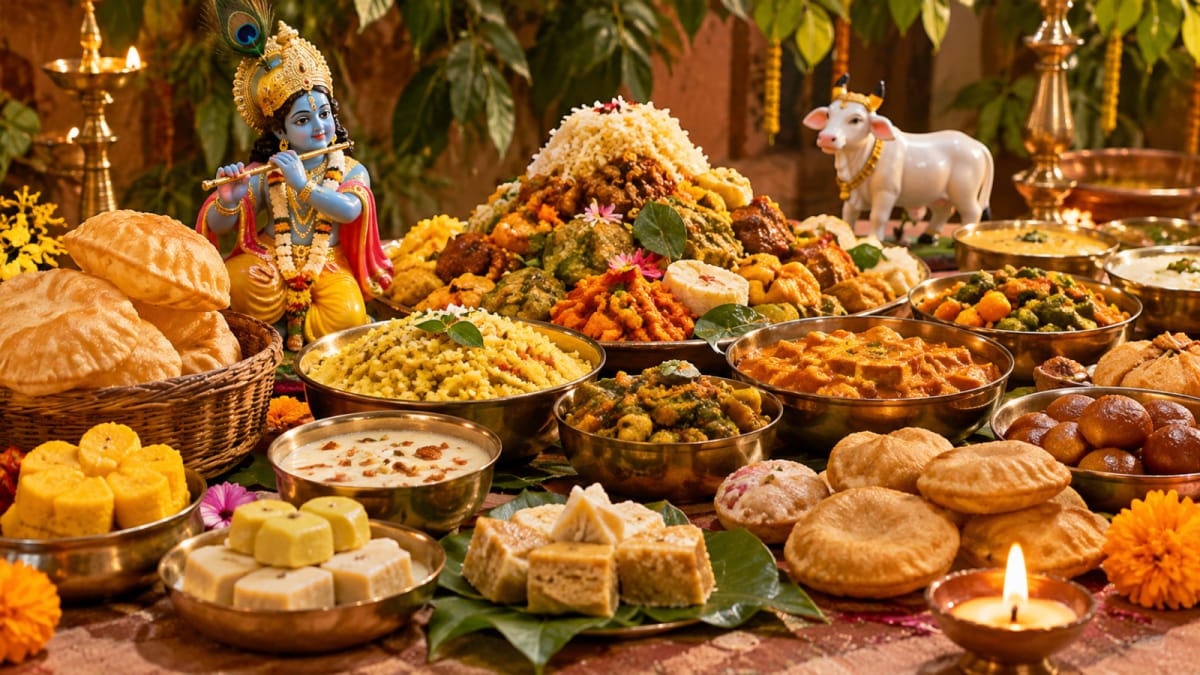
Devotees prepare a variety of vegetarian dishes and arrange them in a large, mountain-like formation before Lord Krishna. The offering can include everything from simple everyday preparations to elaborate festive sweets. Once the prayers are complete, the food is distributed as prasad among devotees.
It is not simply about preparing a lavish meal. The spread represents the harvest, the generosity of nature and the belief that food is a blessing to be respected and shared.
From puri and kadhi to halwa: What goes on the Annakut plate?
There is no single menu that every household or temple follows. The dishes vary across regions and family traditions, but the Annakut spread is typically a generous vegetarian affair.
Puri and traditional breads: Freshly fried puris are a familiar part of the offering, often accompanied by rotis, parathas or other regional breads. Their place on the plate makes sense: they are the perfect companions to the assortment of vegetable preparations and curries.
Seasonal vegetables and Annakut ki sabzi: One of the most distinctive preparations is Annakut ki sabzi, a mixed vegetable dish that brings together several seasonal vegetables. Aloo, kaddu, arbi, gobhi, bhindi, beans and other locally available produce may find their way into the preparation. It is a fitting dish for a festival that celebrates the bounty of the land.
Dal, rice and khichdi: Comforting preparations such as dal, steamed rice and khichdi are also part of many offerings. Kadhi, made with yoghurt and gram flour, is another popular addition in several North Indian traditions.
Savoury treats: Kachoris, pakoras, mathri and other traditional snacks add variety to the spread. Depending on the household or temple, chutneys, papad and other accompaniments may also be included.
Sweets and dairy delicacies: No Krishna-inspired feast feels quite complete without milk-based preparations. Kheer, rabri, peda, laddoo, barfi, halwa and makhan-mishri are among the familiar offerings. Butter and mishri, in particular, have a special association with Krishna’s childhood in Gokul, where he is lovingly remembered as Makhan Chor.
Fresh fruits and dry fruits also feature in the offering, adding to the sense of abundance.
What is Chhappan Bhog, and why are there 56 offerings?
One of the best-known traditions associated with Govardhan Puja is Chhappan Bhog — an offering of 56 different food items to Lord Krishna.
Popular tradition connects the number to the seven days Krishna spent holding up Govardhan Hill. It is believed that Krishna usually enjoyed eight meals a day. While he was protecting the villagers and their cattle, he could not take his usual meals. Once the storm subsided, the villagers expressed their gratitude by preparing 56 offerings for him — eight meals multiplied by seven days.
The traditional spread can include an assortment of sweets, dairy preparations, savoury snacks, breads, rice dishes, lentils, vegetables, fruits and dry fruits. There is no universally fixed menu of 56 items; the selection changes according to regional customs and temple traditions.
In some Krishna temples, particularly in the Braj region, the Annakut celebration is especially elaborate, with vast quantities of food arranged as an offering before being distributed to devotees.
More than a festive feast
Govardhan Puja is also associated with the worship of cows, known as Gau Puja, reflecting their importance in Krishna’s life and in agrarian communities. In many homes, devotees create a symbolic representation of Govardhan Hill, offer prayers and prepare food as part of the day’s rituals.
What makes the occasion particularly interesting is how closely its mythology is tied to everyday life. The story of Krishna lifting a mountain is remembered through a celebration of the land, cattle, crops and food that sustain a community.
And perhaps that is why the feast feels so meaningful. After days of elaborate Diwali menus, sweets and celebratory meals, Annakut brings the focus back to something simpler: gratitude for what is on the table, and the joy of sharing it.
The festive lights may be fading, but the kitchen still has plenty to celebrate.
Quick Answers
 Ask News18
Govardhan Puja commemorates Lord Krishna lifting Govardhan Hill on his little finger for seven days to protect the people and cattle of Vrindavan from torrential rains unleashed by an angered Lord Indra. The festival celebrates humility, gratitude, and respect for the natural resources and land that sustain everyday life.
Ask News18About the Author

Swati Chaturvedi is a seasoned media professional with over 13 years of experience in journalism, digital content strategy, and editorial leadership across top national media houses. An alumna of Lady…Read More
November 09, 2026, 14:01 IST