 By
In this series, features and series developer Heather Nicholls takes you behind the scenes of some of the most compelling brand activations and events.
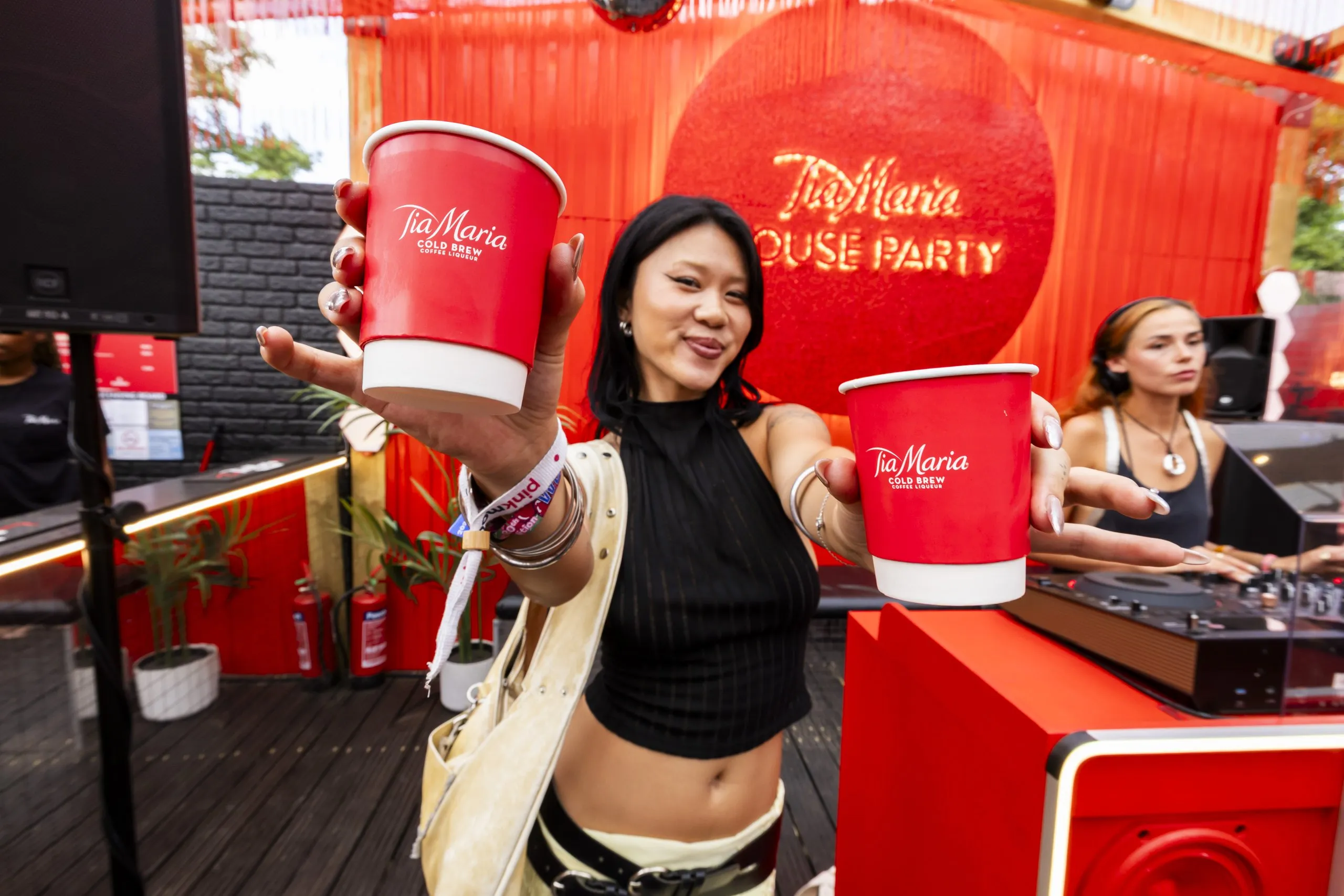
This week, we meet Sense, the agency behind the Tia Maria House Party, for their client Disaronno.
The Brief:
The challenge for this activation was to introduce Tia Maria to a new generation of drinkers.
Olivia Rayner, creative director at Sense explained: “It’s a brand with decades of heritage, which is a wonderful thing, but it also means some younger consumers associate it with an older generation. We needed to help change that perception.
She added: “Music was a natural place to start, and working with Live Nation, festivals gave us an audience already in the mood to discover something new. But we didn’t want to create another festival bar where people grab a drink and move on. We wanted to build somewhere they’d actively choose to spend time.”
“That became our ambition… make Tia Maria part of people’s festival experience, rather than simply another brand advertising within it.”
The Execution:
The inspiration for this activation came from Sense’s HXLab research. The research identified three connected cultural signals – a growing desire to switch off from digital noise, an appetite for more intimate social experiences and the return of 90s nostalgia.
Rayner said: “Then we thought about the social dynamics of a house party. We loved the idea of taking the familiar moments of a house party and giving them a Tia Maria twist. It gave us a creative world that felt nostalgic and playful, but also completely natural within a festival.”
Once the agency had landed on the house party concept, they mapped out the experience room by room, considering what people would see, hear and do and where they wanted to stay.
Rayner explained: “The design aesthetic was contemporary, stylish whilst also leaning into a trending 90s moodboard. The kitchen became the social heart, with the bar serving Tia Maria Espresso Martinis and other cocktails. The living room was filled with retro vinyl, vintage TVs and a fridge full of music delight props. The bathroom had empowering lipstick messages on the mirrors and a bathtub that became one of our most popular photo moments.”
She added “Then there was the dancefloor. We wanted guests to feel part of the music, so we created a 360° boiler room style DJ setup where people could gather all around the decks rather than watch from a distance.”
Sense also designed the experience to change throughout the day. Rayner said: “It needed to be inviting in the afternoon, but really come alive after dark and because it was touring three festivals, we had to make sure it could adapt to different sites without losing its personality.”
She added: “There was an enormous amount of thought behind the little things. Which, of course, are often the things people notice most.”
The activation was a really collaborative project, with the Tia Maria team being very involved throughout the process.
As well as collaborating with the Tia Maria team, the agency also had to work closely with the Live Nation Festival teams because the activation was touring the three different festivals, each with different personalities, requirements and operational consideration.
Rayner cited Wildreness Festival as a good example of this. The festivals distinctive aesthetic meant that they had to adapt part of the design, introducing more greenery and softening some of the overt branding so the House Party felt at home there.
This balance of consistency and flexibility was one of the biggest challenges in planning and executing this event. Rayner explained: “We’d created this very particular world, with its own personality and lots of carefully considered details. But we then had to make it work across three festivals with different audiences, environments and requirements. We couldn’t simply drop the same structure into every site and assume it would work.”
They also had to ensure they were using eco methods and materials to fit in with strict production guidelines.
Rayner said: “I think the best client-agency relationships are the ones where everyone feels like they’re working towards the same thing, rather than operating on opposite sides of a table. This definitely felt like one of those projects and we were so grateful for that, as know it always leads to the best work.”
The weather was also a challenge, as the festivals took place during two extreme heatwaves, with temperatures reaching around 34 degrees. This meant that the agency had to adapt working practices during build so that the team stayed hydrated and had enough breaks.
The Results:
Across all three festivals, the house party welcomed 20,500 visitors, with an average dwell time of 25 minutes. Rayner said: “When you consider how much is competing for people’s attention at a festival, that’s a significant amount of time to spend with a brand.”
Espresso Martinis accounted for 23% of cocktail sales, which helped to build the association between Tia Maria and one of its key serves. The campaign also delivered more than 5.3 million media impressions and 500,000 engagements.
The Jake Shears content achieved engagement rates of up to 28% – nearly six times the benchmark.
The biggest indication of success though is that the House Party is set to return for 2027. Rayner said: “We’re not just talking about a one-off activation anymore. We’ve created a platform the brand wants to build on.”
One festival goer in their 20s told the agency team that they hadn’t really heard of Tia Maria before, but after visiting the House Party, they thought it was a cool brand. The agency also heard people say they’d spent more time in the activation that anywhere else. Rayner said: “That might sound like a small thing but it was exactly what we’d set out to achieve.”
Trends and Learnings:
In terms of trends, Rayner outlines that people are increasingly drawn to experiences that feel genuinely social, playful and human. She said: “There’s so much pressure for everything to be content-worthy now, and brands can sometimes get a little carried away designing for the camera rather than the person actually standing in front of them.
She added: “Of course, we wanted the House Party to generate brilliant content. But we started by asking whether it would be a great experience in its own right. Could you have fun there? Would you want to bring your friends? Would you still enjoy it if you never posted a single photo? That’s a really important distinction. We’re seeing more appetite for experiences that encourage people to participate, connect and be present, rather than simply observe, or take photos from the sidelines. And I think that’s a lovely direction for experiential to be moving in.”
From this project the Sense team learnt that people are very generous with their time when you give them a good reason to be. Rayner said: “We often talk about capturing attention in experiential, but I think there’s a more interesting question. What are we giving people in return for it? With the House Party, we focused on creating somewhere people genuinely wanted to be. Good music, great drinks, playful details, somewhere to sit with friends and a few unexpected surprises. The result was that people stayed, came back and brought others with them.”
She added: “That’s something I’ll definitely take into future projects: don’t just design for the moment someone walks in. Design for all the reasons they’ll want to stay.”