 By
[ad_1]
Last Updated:
Shilpa Shetty shares a tennis ball coordination challenge that tests focus, reflexes and motor control. Here’s how to try it and what her earlier mobility challenge teaches us.




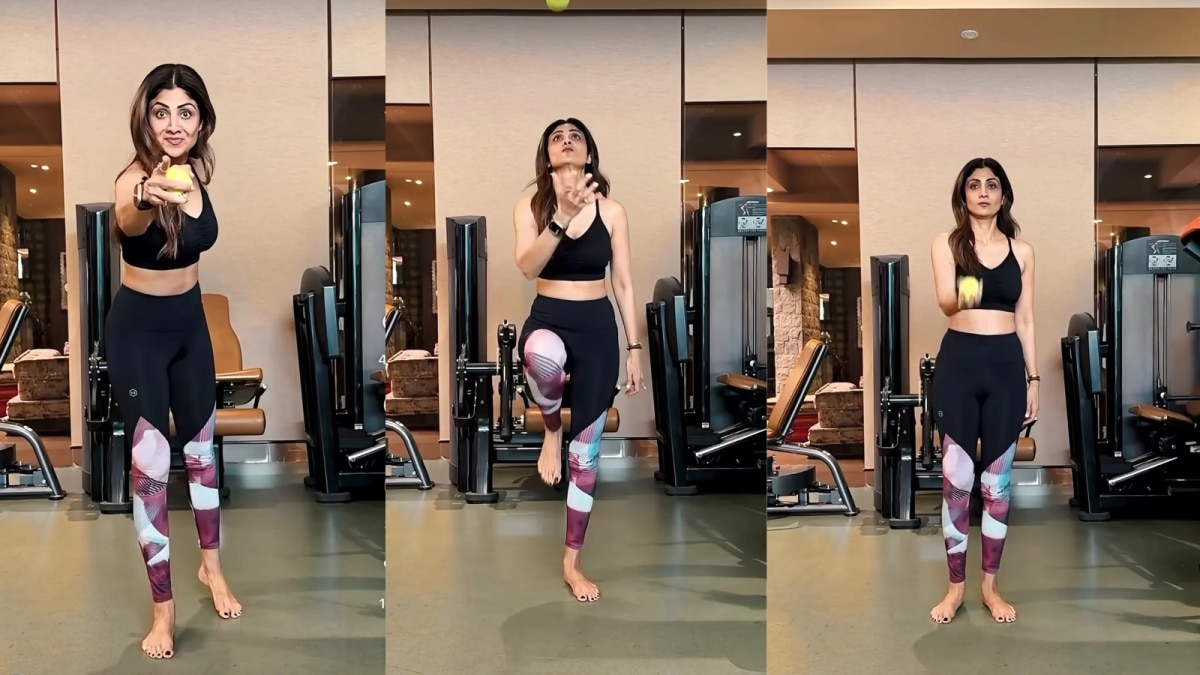
Shilpa Shetty demonstrates a tennis ball coordination exercise as part of her Monday Motivation series, challenging followers to test their focus and reflexes.
Shilpa Shetty has found another way to make Monday motivation a little more interesting. The actor, who regularly shares snippets of her fitness routine on social media, is back with a challenge that requires more than physical strength. This time, she is asking followers to put their reflexes, concentration and coordination to the test, with something as simple as a tennis ball.
In her latest Instagram video, shared as part of her Monday Motivation series, Shilpa demonstrates a tennis ball coordination exercise that looks deceptively easy. Standing upright, she tosses a ball into the air with one hand. Before catching it with the same hand, she quickly lifts one knee and touches her shoulder with her other hand. The sequence requires her to complete multiple movements while keeping her eyes on the ball.
Sharing the video, she wrote, “One ball, multiple moves and a whole lot of concentration…Sounds simple? Give it a try and find out!” She also encouraged followers to attempt the challenge and tag her in their videos.
Why Shilpa Shetty’s Tennis Ball Exercise Is More Than Just A Reflex Challenge
According to Shilpa, ball exercises can do more than make a workout entertaining. They bring together different aspects of physical and mental coordination, requiring the brain to process visual information while the body responds with controlled movements.
The tennis ball challenge involves tracking the ball, judging its movement, timing the catch and coordinating the knee lift and shoulder touch within a short window. This makes it a useful way to practise hand-eye coordination, attention and motor control.
Shilpa also highlighted several potential benefits of such exercises, including:
Improved concentration: Following the ball while performing another movement requires sustained attention.
Better hand-eye coordination: Tracking and catching the ball encourages the eyes and hands to work together.
Motor control: The exercise requires the body to execute different movements in a coordinated sequence.
Cognitive flexibility: Switching between the ball toss, knee lift and shoulder touch requires the brain to adapt to multiple actions.
Body awareness: Coordinating the upper and lower body encourages greater awareness of movement and positioning.
There is scientific support for the broader idea that physical activity can benefit cognitive health. A 2025 umbrella review published in the British Journal of Sports Medicine, which examined 133 systematic reviews and meta-analyses covering more than 2,700 randomised controlled trials, found that exercise was associated with improvements in general cognition, memory and executive function. However, this does not establish that one particular tennis ball drill can prevent brain fog or improve memory on its own.
How To Try The Tennis Ball Challenge At Home
You do not need an elaborate gym set-up to attempt this exercise. Start with a tennis ball and enough clear space around you.
Stand upright with your feet comfortably apart and hold a tennis ball in one hand.
Toss the ball upwards, keeping it within a comfortable catching distance.
While the ball is in the air, lift one knee and touch your opposite shoulder with your free hand.
Bring your hand back into position and catch the ball with the hand that tossed it.
Repeat the movement, alternating knees as your coordination improves.
Start slowly and focus on catching the ball consistently before increasing the speed or adding more complicated movements. If you struggle with balance, try the exercise while seated or leave out the knee lift until you feel comfortable.
Shilpa Shetty’s Previous No-Hands Floor-To-Standing Challenge Tested Strength And Mobility
This is not the first time Shilpa has challenged her followers to look beyond conventional workout routines. In an earlier fitness video, the actor demonstrated a floor-to-standing movement that tested lower-body strength, balance and mobility.
She began by sitting on the floor in a cross-legged Gomukhasana-inspired position. From there, she pushed herself up into a standing position without using her hands for support. She then turned around and lowered herself back into the same seated position, once again without placing her hands on the floor.
The movement looks straightforward when Shilpa performs it, but it requires considerable control. The quadriceps, glutes, hamstrings and core all contribute to the transition, while hip and ankle mobility and balance are equally important.
The actor described the exercise as a useful indicator of lower-body strength, balance and mobility. She also advised people to take appropriate safety precautions while attempting it.
Why The Ability To Get Up From The Floor Matters
Getting up from the floor is something most people rarely think about until it becomes difficult. However, the ability to lower oneself to the ground and return to standing involves several components of functional fitness.
A systematic review published in the International Journal of Environmental Research and Public Health examined the supine-to-stand task across different age groups. It found that the movement can be a useful way of assessing functional motor competence and musculoskeletal fitness.
The exercise involves several physical abilities working together:
Lower-body strength: The quadriceps and glutes help generate the force needed to rise.
Core stability: The abdominal and surrounding muscles help maintain control during the transition.
Hip and ankle mobility: Adequate joint movement makes it easier to shift between seated, crouched and standing positions.
Balance: Maintaining stability while changing levels is essential to completing the movement safely.
Coordination: Different muscle groups need to work together to make the transition smooth.
It is worth remembering that the ability to perform this movement is not a standalone measure of overall health. Individual differences in joint health, flexibility, age and physical condition can affect performance.
The Bigger Fitness Lesson: Train For Movement, Not Just Muscles
What makes Shilpa’s fitness challenges interesting is that they focus on abilities that are useful beyond the gym. Catching a ball while coordinating another movement, or getting up from the floor without support, may look like small achievements, but both require the body to respond to different physical demands.
The World Health Organization also emphasises the importance of varied physical activity. Its guidelines recommend that older adults incorporate activities focusing on functional balance and strength into their weekly routines to maintain physical capacity and help prevent falls.
Of course, not everyone needs to attempt Shilpa’s challenges at the same level. Those with knee or hip problems, recent injuries, balance difficulties or other medical concerns should seek professional guidance before trying demanding movements. For the floor-to-standing exercise, a non-slip surface and sturdy support nearby are particularly important.
The takeaway? Fitness is not only about lifting heavier weights or completing another set of repetitions. It is also about building the strength, balance, coordination and control that help us move confidently through everyday life.
Quick Answers
 Ask News18
According to Shilpa Shetty, the tennis ball challenge helps improve concentration, hand-eye coordination, motor control, cognitive flexibility, and body awareness by requiring the brain to process visual information while the body responds with controlled movements and synchronized actions.
Ask News18About the Author

Swati Chaturvedi is a seasoned media professional with over 13 years of experience in journalism, digital content strategy, and editorial leadership across top national media houses. An alumna of Lady…Read More
November 18, 2026, 08:07 IST
[ad_2]
Source link