By
Europe’s Hera spacecraft has sent back the first close-up images of the asteroid NASA deliberately struck in 2022 — and found a crater spanning the asteroid’s entire face, a world tumbling chaotically, and hundreds of unexpected boulders circling the pair.
By The BNN Media
The Best News Network
News Beyond the Borders
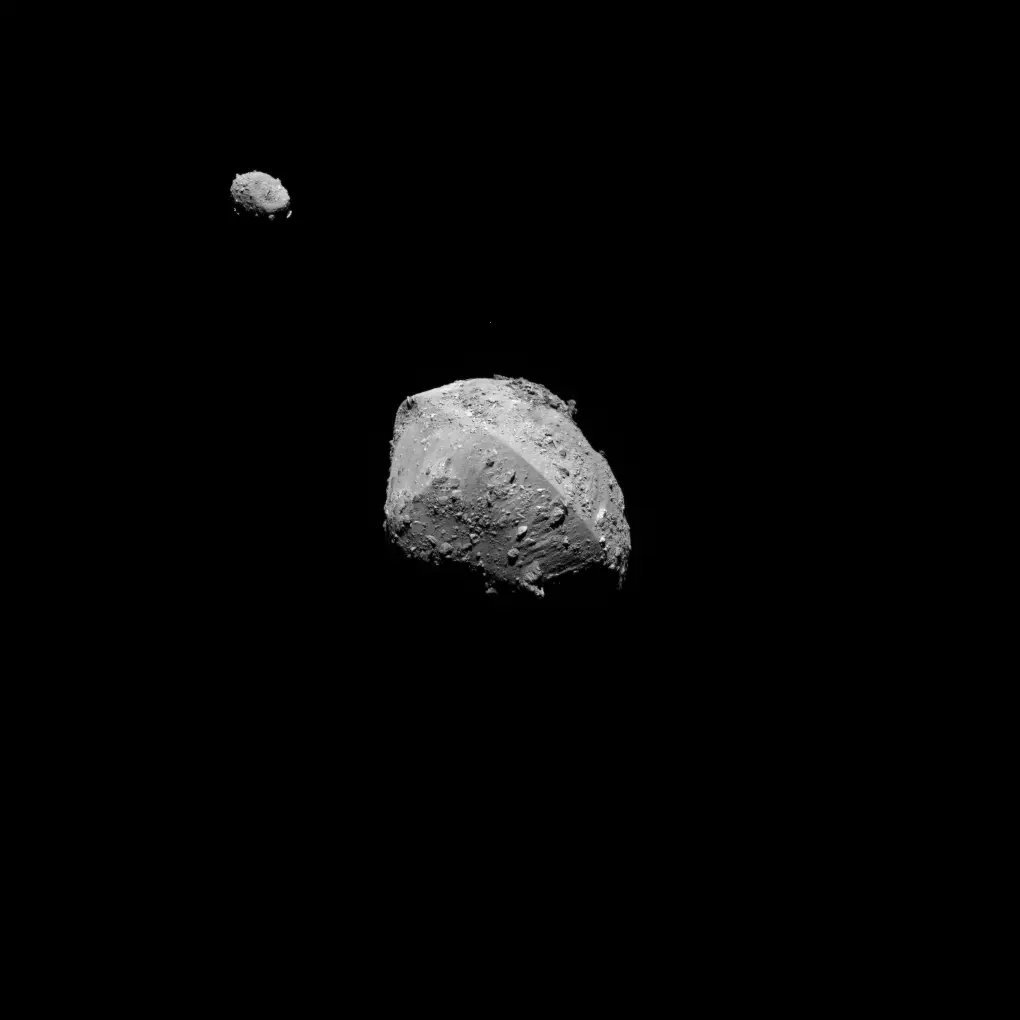
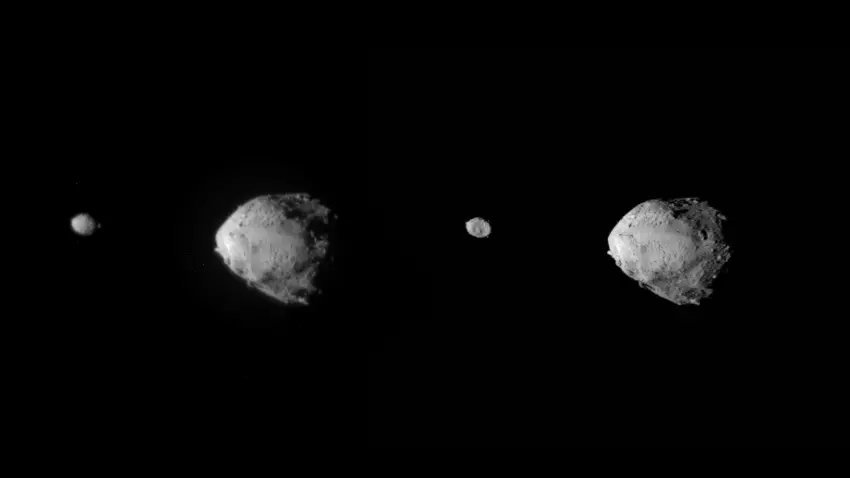
Berlin, Germany — The European Space Agency (ESA) has revealed the first close-up images of the asteroid Dimorphos since NASA’s DART spacecraft slammed into it in 2022, showing that the impact left a stadium-sized crater flattening one whole face of the small asteroid. The images, unveiled on Wednesday, 25 November 2026, also show Dimorphos tumbling chaotically in its orbit and surrounded by hundreds of previously unknown boulders.
The crater that changed an asteroid’s face
On 26 September 2022, NASA’s Double Asteroid Redirection Test (DART) spacecraft deliberately crashed into Dimorphos at about 14,000 miles per hour (22,530 km/h) in humanity’s first test of planetary defence — the idea that an asteroid on a collision course with Earth could be nudged aside. Telescopes on Earth measured the result: Dimorphos’s orbit around its larger companion, Didymos, was shortened by 33 minutes, far more than scientists had predicted.
But one fundamental question remained unanswered for four years: what had actually happened to Dimorphos itself? Hera has now answered it. The face struck by DART has been flattened into an impact crater the size of a sports stadium, extending across the asteroid’s entire width, as if a piece of the asteroid had been cut off.
‘Scientists debated whether Dimorphos had sustained an impact crater, changed its shape or stayed the same,’ said Hera principal investigator Patrick Michel, director of research at CNRS and the Observatoire de la Côte d’Azur. ‘Much to our surprise the answer turns out to be all three at once! The face struck by DART has been flattened into an impact crater the size of a sports stadium, which extends across the asteroid’s entire width.’
The rest of Dimorphos, by contrast, looks much as it did before. The boulder fields covering its other regions look just like they did in DART’s 2022 images, and scientists said they saw no evidence of major changes on the side opposite the impact — a combination the mission team called surprising.
The impact did not just move Dimorphos — it remade one whole side of it, while leaving the other side almost untouched.
A world tumbling out of control
The second surprise was how Dimorphos now moves. Before the impact it rotated in a steady, predictable way as it circled Didymos. Hera’s images show that has changed completely.
‘In addition, as Hera returned more images, it became clear that the DART impact has left Dimorphos tumbling wildly in its orbit,’ said Michael Kueppers, ESA’s Hera mission scientist.
Planetary scientist Sabina Raducan, of the International Space Science Institute in Bern and the Free University of Brussels, described the crater at the mission’s first-images briefing in Berlin: ‘It’s a big crater that is almost as large as the body itself, which is really spectacular.’ At the crater’s centre sits an apparent mound — described by researchers as a cigar-shaped structure — though its exact nature is hard to pin down at the current image resolution.
Because the rotation is now chaotic, the mission team cannot yet predict which face Dimorphos will be showing Hera when it takes its next photographs. Dimorphos is about 151 metres (495 feet) wide, orbiting the 730-metre (2,395-foot) Didymos, and the pair is currently about 193.5 million kilometres (120 million miles) from Earth.
A single spacecraft impact changed not only the asteroid’s shape, but the way it spins — and scientists are still learning how wild that tumble really is.
Hundreds of unexpected boulders
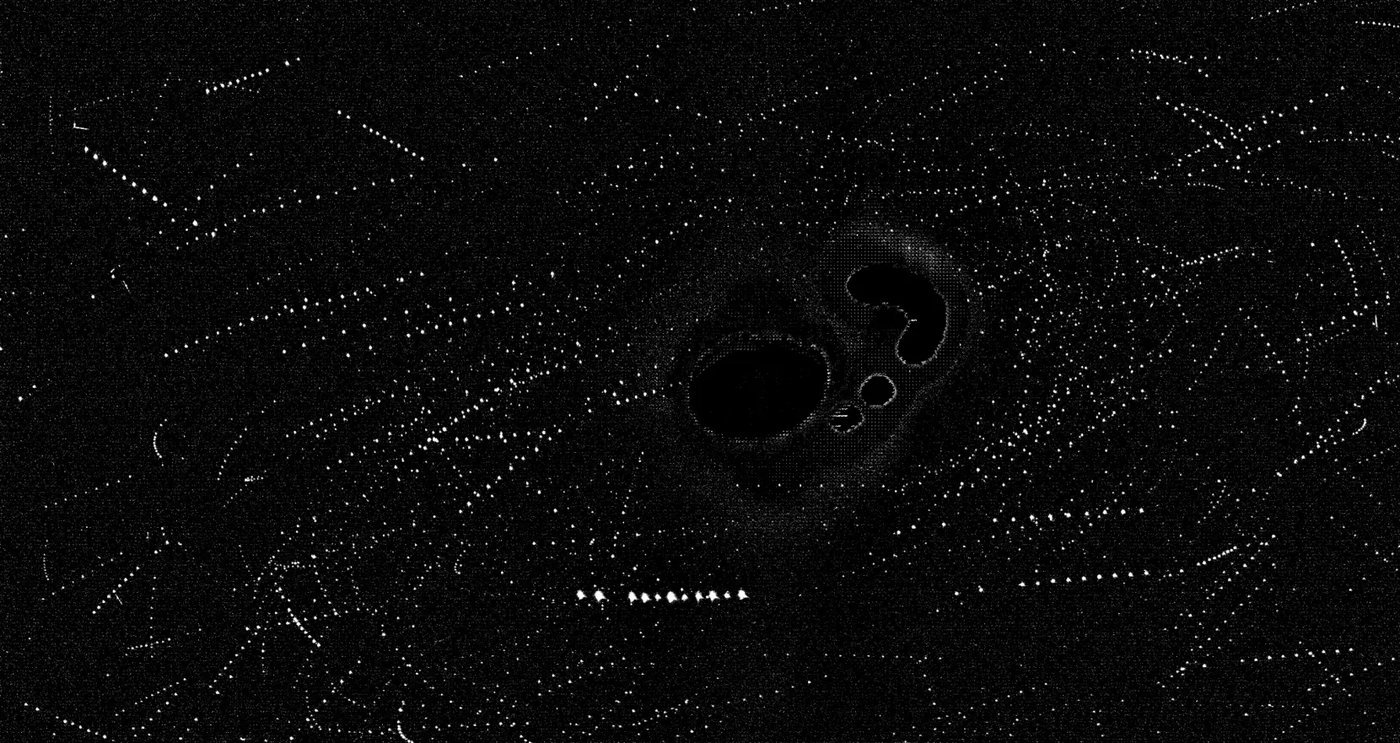
The third surprise may be the most important for future missions. Hera found the Didymos–Dimorphos pair surrounded by hundreds of orbiting boulders, each a few metres across, that nobody knew were there.
‘Another big surprise is that Hera is showing that the asteroids are surrounded by hundreds of orbiting boulders, just a few metres in size,’ said Kueppers. ‘The team will have to take account of these objects in the coming weeks as the mission moves in closer to acquire higher-resolution images of the asteroids.’
More than 100 of the boulders are between the size of a football and a washing machine, according to planetary scientist Naomi Murdoch of the University of Toulouse, a member of the mission team. Their origin is unclear, and tracking them has become an urgent task: the boulders are a collision risk as Hera manoeuvres closer to the pair.
The boulders were revealed in a composite image made from 11 long-exposure shots taken by Hera’s Hyperscout H camera on 3 November, in which the dotted trails mark the paths of hundreds of rocks in motion around the two asteroids. The asteroids themselves were removed from that image to make the boulder trails easier to see.
The asteroid pair turned out to be far more crowded — and far more hazardous to navigate — than anyone had expected.
How Hera got there
Hera, about the size of a small car, was launched in October 2024 and arrived at the Didymos–Dimorphos system in October 2026, two years after leaving Earth. It is ESA’s first planetary defence mission, built by a consortium of 18 ESA member states led by OHB in Germany, with contributions from international partners including Japan’s space agency, JAXA.
The spacecraft is now observing from about 25 to 30 kilometres away, using its thrusters to maintain slow, rectangular orbits around the two ultra-low-gravity bodies at an average speed of just 12 centimetres per second. It carries three instruments: the monochrome Asteroid Framing Camera, the multi-spectral Hyperscout H camera, which observes in 25 separate colours at once, and JAXA’s Thermal Infrared Imager, TIRI, which measures surface temperatures.
The first images were unveiled by Hera mission manager Ian Carnelli in the dinosaur hall of the Museum für Naturkunde in Berlin — chosen, ESA said, as a fitting reminder of why planetary defence matters. ‘Sixty-six million years ago, an asteroid impact changed the course of life on Earth,’ Carnelli said. ‘Today, for the first time in history, humanity is validating how to prevent such an event from happening again.’
ESA Director-General Josef Aschbacher called the mission ‘international collaboration at its best’, with NASA having demonstrated that an asteroid can be deflected and ESA now providing the detailed scientific investigation of how that deflection worked.
Hera’s arrival turned a four-year-old experiment into a close-up investigation — and the first results were more dramatic than the team had dared to hope.
What comes next
The first images are the beginning, not the end, of Hera’s work. In December 2026, the spacecraft is scheduled to approach to around 13 kilometres from the asteroid pair, returning progressively higher-resolution images. In January 2027, it plans to deploy two shoebox-sized CubeSats that will venture closer still:
- Juventas, led by Luxembourg, will use low-frequency radar to probe an asteroid’s interior for the first time and will eventually attempt a landing
- Milani, led by Italy, will prospect asteroid materials and the surrounding dust
Operating together, Hera, Juventas and Milani will form a three-spacecraft system around the two asteroids, measuring their physical properties and the aftermath of the DART impact in detail.
The mission is also a stepping stone to ESA’s next planetary defence project, Ramses, being developed with JAXA to study the asteroid Apophis during its exceptionally close — but entirely safe — flyby of Earth on Friday, 13 April 2029, passing about 32,000 kilometres above the surface. Ramses will watch how Apophis responds to Earth’s gravity, while Hera shows what happens when humanity strikes an asteroid on purpose.
‘Hera is helping us understand the consequences of deliberately striking an asteroid,’ said Holger Krag, head of ESA’s Space Safety programme. ‘Ramses will investigate how an asteroid responds to the gravitational influence of a planet. Together, these missions will significantly expand the scientific knowledge available to planetary defence.’
It follows Voyager 1’s journey to one light-day from Earth, another milestone in humanity’s exploration of deep space — but where Voyager travelled farther than any human-made object, Hera is answering a more practical question: if an asteroid ever threatened Earth, could we really push it aside?
Four years after DART proved an asteroid’s orbit can be changed, Hera is proving what that change really costs the asteroid — and whether the technique can be trusted when it matters most.
By The BNN Media
The Best News Network
News Beyond the Borders
Sources: ESA, ‘Hera reveals stadium-sized asteroid crater from spacecraft impact’ (25 Nov 2026); Reuters, ‘New images reveal crater on asteroid struck by DART spacecraft’ (25 Nov 2026); CNN, ‘New images reveal stadium-size crater left by humanity’s first planetary defense test’ (25 Nov 2026); Sky & Telescope, ‘Hera’s Images of Smashed Asteroid Moon Dimorphos, Unveiled’ (25 Nov 2026); Instituto de Astrofísica de Canarias (25 Nov 2026).