By
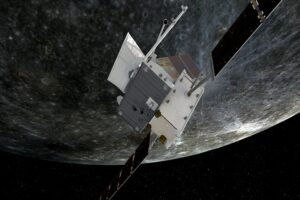
After eight years and nearly 10 billion kilometres of travel, the European-Japanese spacecraft BepiColombo has entered orbit around Mercury — only the second mission in history to achieve the feat, and the first in more than a decade.
By Salman Qureshi
Cameraman / Photographer | The BNN Media – The Best News Network
News Beyond the Borders
Darmstadt, Germany — BepiColombo fired its thrusters for 37 minutes on Saturday 21 November and was captured by the gravity of Mercury, the smallest and innermost planet in the Solar System, the European Space Agency (ESA) confirmed. The spacecraft had travelled for more than eight years since its launch in October 2018, covering about 9.9 billion kilometres on a winding route that used the gravity of Earth, Venus and Mercury itself as brakes.
There was a scare in the final moments. ESA said on Sunday that the thruster burn during the manoeuvre was shorter than planned following a software issue — but that the spacecraft is safe and teams at its operations centre in Darmstadt are working to understand what happened. Further updates were expected on Monday.
The 37-Minute Burn
The capture burn began at 18:24 UTC on 21 November, as the stacked pair of orbiters approached the night side of Mercury over its south pole. Four chemical thrusters fired against the spacecraft’s direction of travel, slowing it just enough for Mercury’s weak gravity to hold it.
The technique, known as weak stability boundary capture, brings the spacecraft into Mercury’s neighbourhood already moving at nearly the planet’s own speed, so that a comparatively modest push near closest approach is enough for the planet to catch it. It is, ESA has said, one of the most complex orbital insertions ever attempted.
Flight controllers confirmed the capture soon afterwards. “We’ve heard back from Bepi — the spacecraft is now in contact with Ground and the teams at ESOC are busy assessing the telemetry, but Flight Dynamics already has confirmed it achieved orbital capture around Mercury!” ESA Operations said in a post on Sunday.
The glitch did not undo the achievement: the spacecraft is in orbit. But it was a reminder of how finely balanced the arrival was — and engineers will want to know exactly why the burn ended early before the next manoeuvres begin.
Eight years of travel, and the hardest part was the last 37 minutes.
Why Mercury Is So Hard to Reach
Mercury is the least explored of the four rocky planets — and reaching it is, in energy terms, harder than reaching Pluto. The problem is the Sun. Everything that falls towards the Sun gains speed, and a spacecraft diving towards Mercury arrives moving far too fast for the small planet’s weak gravity to catch.
BepiColombo could not carry enough fuel to brake the normal way. Instead, it spent eight years shedding speed:
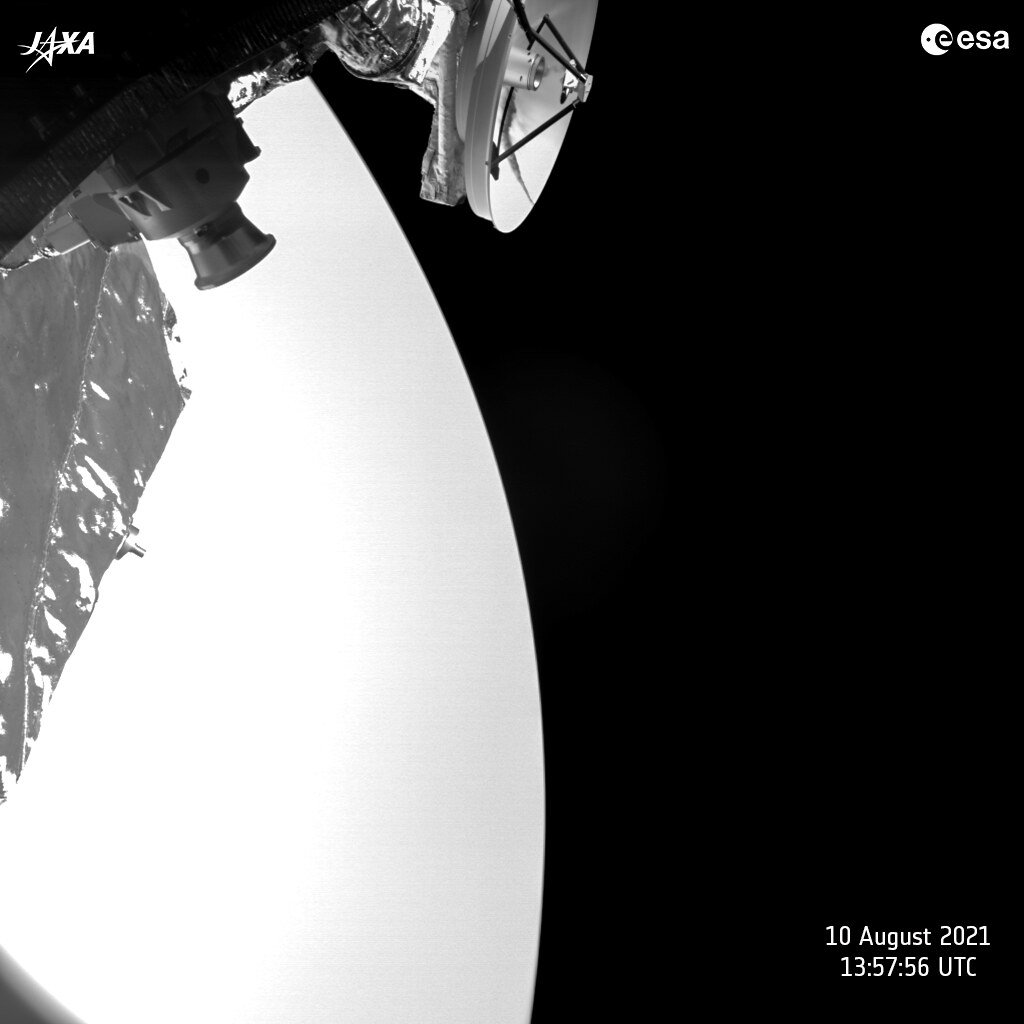
- Nine planetary flybys — one of Earth (April 2020), two of Venus (October 2020 and August 2021) and six of Mercury itself (October 2021 to January 2025) — each one trading away orbital energy.
- Solar-electric propulsion — xenon ion thrusters on the Mercury Transfer Module, pushing gently but for months at a time, powered by two 15-metre solar wings.
- About 9.9 billion kilometres travelled — roughly 6 billion miles, far more than the straight-line distance to Mercury, because the route was a long inward spiral.
The journey was originally due to end in December 2025. But in April 2024 the transfer module developed a power fault that cut the thrust of its electric engines, and mission planners had to redesign the route in mid-flight — a change that pushed the arrival back by about 11 months, to November 2026.
BepiColombo did not fly to Mercury. It fell towards the Sun for eight years, braking all the way down.
Two Orbiters, One Stack
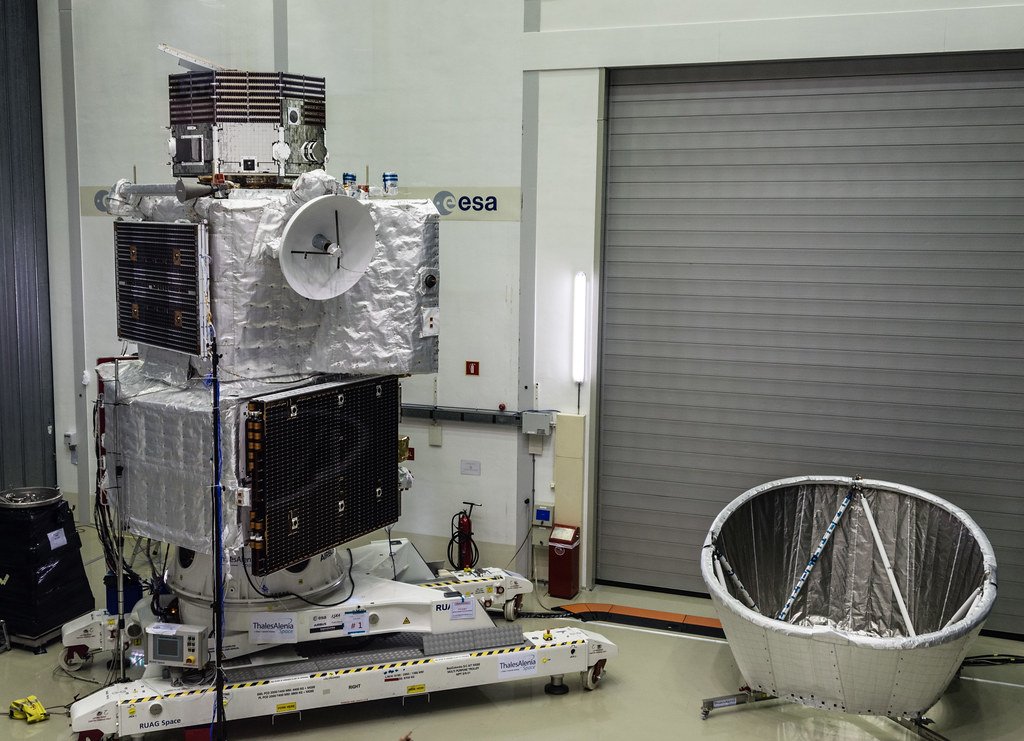
BepiColombo is not one spacecraft but two, travelling as a single stack. ESA built the Mercury Planetary Orbiter (MPO), which will map the surface and study the planet’s interior. The Japan Aerospace Exploration Agency (JAXA) built the Mercury Magnetospheric Orbiter, known as Mio, which will study Mercury’s magnetic field and the charged particles around the planet.
A third element, the ESA-built Mercury Transfer Module (MTM), carried the two orbiters to Mercury with its electric thrusters and large cruise solar arrays. It separated from the orbiters on 3 September 2026 and was left in its own orbit around the Sun, leaving the European orbiter to fly the stack with its own chemical thrusters for the final approach.
The two science orbiters will remain joined together for now. They are due to separate from each other on 9–10 December 2026, after a series of manoeuvres lowers their orbit. The MPO will then gradually descend until March 2027, when it reaches its final science orbit, between 400 and 1,500 kilometres above the surface.
The mission is named after Giuseppe “Bepi” Colombo, the Italian scientist who worked out the orbit that let NASA’s Mariner 10 fly past Mercury three times in the 1970s.
What BepiColombo Will Study
Mercury is a world of extremes, and it still holds basic mysteries. BepiColombo’s science phase, due to begin in April 2027 and last at least one Earth year, will seek to answer questions that no mission has settled:
- Why does Mercury have a magnetic field at all? It is the only rocky planet besides Earth with a global magnetic field, yet its core should have cooled long ago.
- Why is there water ice in the polar craters of a sun-scorched planet? Ice survives in permanently shadowed craters near the poles, where sunlight never reaches.
- What are the “hollows”? Enigmatic shallow depressions pockmark the surface, and nobody knows how they form.
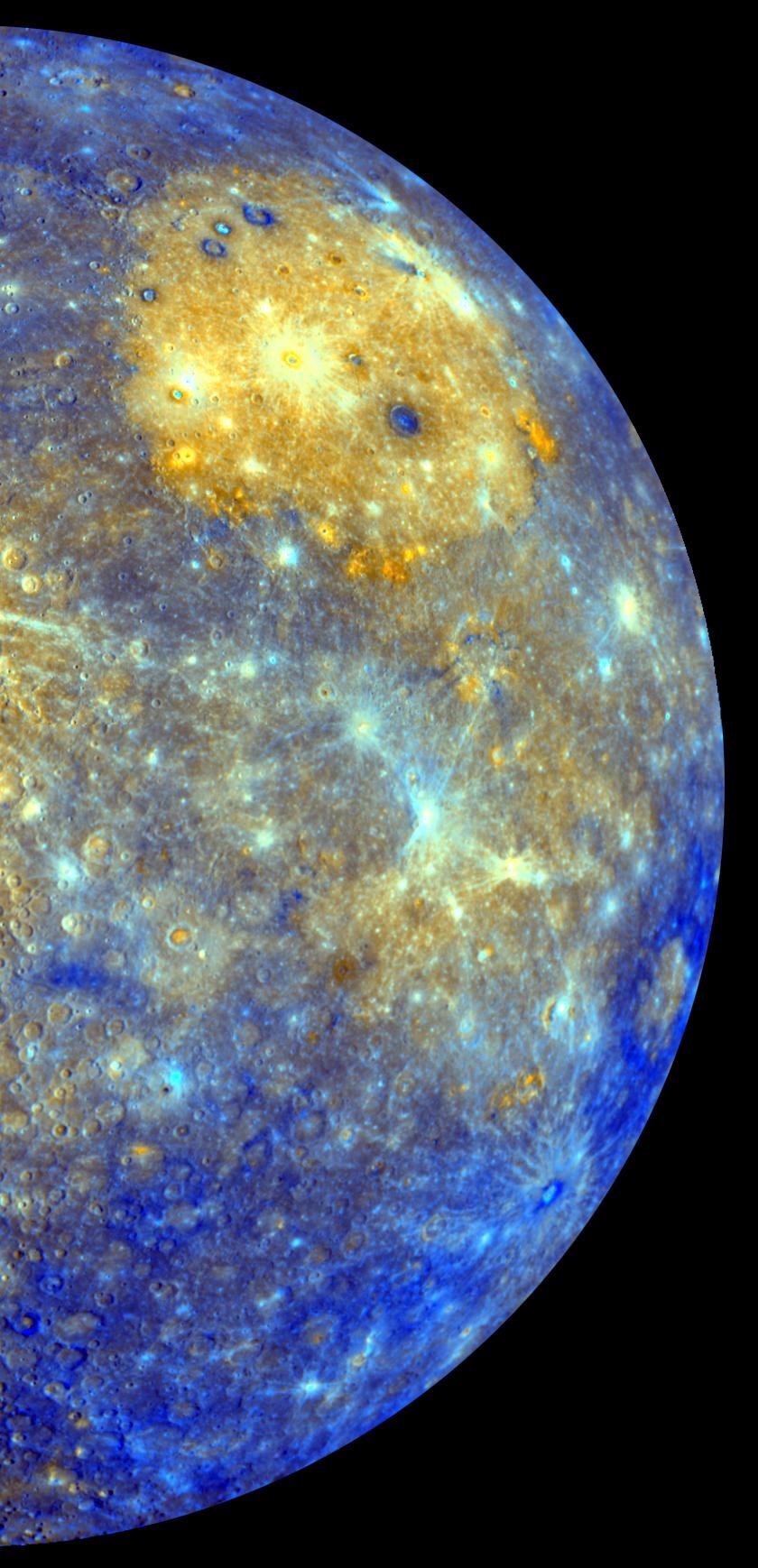
Mercury itself is only slightly larger than Earth’s Moon. It sits about 60 percent closer to the Sun than Earth does, so from its surface the Sun appears more than three times as large and seven times as luminous as it does from Earth. Its diameter is 4,880 kilometres — less than 40 percent of Earth’s. Its surface looks much like the Moon’s, covered in impact craters, with expanses of smooth terrain and cliffs up to 1.6 kilometres tall.
Two orbiters watching the same planet from different angles — one mapping the surface and interior, the other sampling the magnetic field and the space around it — is what makes this mission different from everything that came before.
Only the Third Visitor
BepiColombo is only the third spacecraft ever to reach Mercury, and just the second to orbit it.
NASA’s Mariner 10 made the first close-up observations during three flybys in 1974 and 1975, returning the first close images of the planet and discovering its magnetic field. Then came NASA’s MESSENGER spacecraft, launched in August 2004, which became the first to orbit Mercury when it entered orbit on 18 March 2011. MESSENGER mapped the entire surface, took nearly 100,000 images in its first year alone, and found evidence of water ice in permanently shadowed polar craters before its fuel ran out and it crashed into the surface on 30 April 2015.
That left Mercury unvisited for more than a decade — the least explored of the inner planets — until BepiColombo’s arrival on Saturday.
It has been a remarkable month for spaceflight: BNN also reported last week on SpaceX’s Starship Flight 15, which deployed 26 Starlink satellites and made history with the first tower catch from orbit.
What Happens Next
The months ahead are a careful sequence. After the two orbiters separate on 9–10 December, the MPO will spend the following months lowering its orbit step by step, with about 16 manoeuvres planned over roughly six months. It should reach its final science orbit in March 2027, and both spacecraft will switch on their full instrument suites for routine science operations in April 2027.
The first results will take time. But the questions BepiColombo was built to answer — about Mercury’s magnetic field, its ice, its hollows and its oversized core — are questions about how rocky planets form and survive next to a star. Mercury is the extreme case, and understanding it helps explain Earth, Venus and Mars too.
For now, the spacecraft is safe in orbit, and the teams in Darmstadt are studying the short burn. Eight years, nine flybys and nearly 10 billion kilometres are behind it. The science is about to begin.
Reporting based on Reuters, 22 November 2026; ESA, November 2026; Nature, 21 November 2026; NASA; EarthSky, 22 November 2026.
By Salman Qureshi
Cameraman / Photographer | The BNN Media – The Best News Network
News Beyond the Borders