By
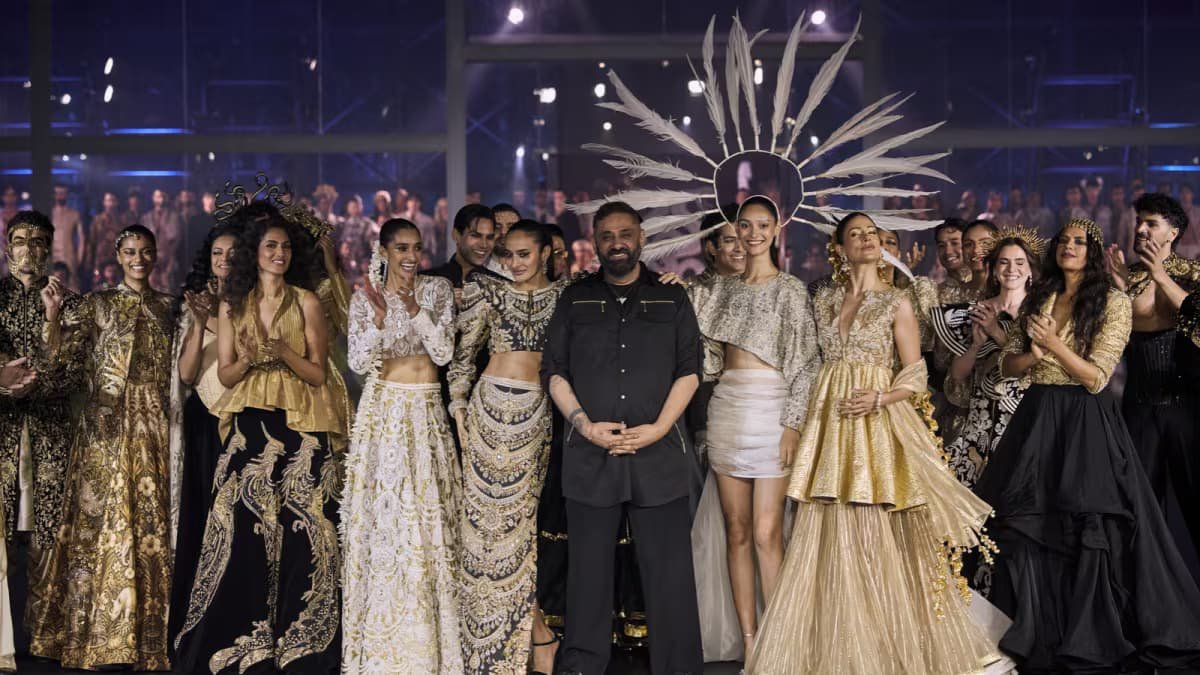
Twenty-five years after he first presented his work in New Delhi, designer Siddartha Tytler brought some of India’s most celebrated models back to the runway for a show titled ‘UNAPOLOGETIC’ — a maximalist couture collection in gold, black and ivory that fused traditional Indian craftsmanship with modern design.
By The BNN Media
The Best News Network
News Beyond the Borders
NEW DELHI, India — Designer Siddartha Tytler celebrated 25 years in fashion with a spectacular runway show titled ‘UNAPOLOGETIC’, held in New Delhi on Tuesday, 18 November, showcasing his latest couture collection in a reunion for some of India’s most celebrated models. Nayanika Chatterjee, Carol Gracias, Sheetal Mallar and Lakshmi Rana — names that defined Indian fashion’s golden era — walked the ramp, in a show styled and curated by celebrity stylist Anaita Shroff Adajania.
A Quarter-Century, Celebrated on the Runway
Tytler is a Delhi-based designer who presented his first show at the Hyatt Regency in New Delhi shortly after returning to India in 2002, and has been a member of the Fashion Design Council of India (FDCI) since 2006. The anniversary show marked a full 25 years of his label — a career built on opulence, theatrical silhouettes and what he has called an “unapologetic embrace of decadence”.
The evening was deliberately a reunion as much as a launch. The return of the veteran models — Chatterjee, Gracias, Mallar and Rana — gave the show its nostalgic charge, bringing back faces that had defined Indian runways in an earlier era to walk alongside the new collection. The show was styled and curated by Anaita Shroff Adajania, one of India’s best-known celebrity stylists, who played a central role in bringing Tytler’s vision to life.
Twenty-five years in, Tytler did not look back quietly — he put the models who made his era on the runway and let the clothes make the argument.
The Collection: Maximalism in Gold, Black and Ivory
The ‘UNAPOLOGETIC’ collection — presented as Unapologetic Couture 2026 — was conceived as an unapologetic expression of maximalism, in which ornamentation takes centre stage and restraint is, in the words of one preview, “simply left at the door”.
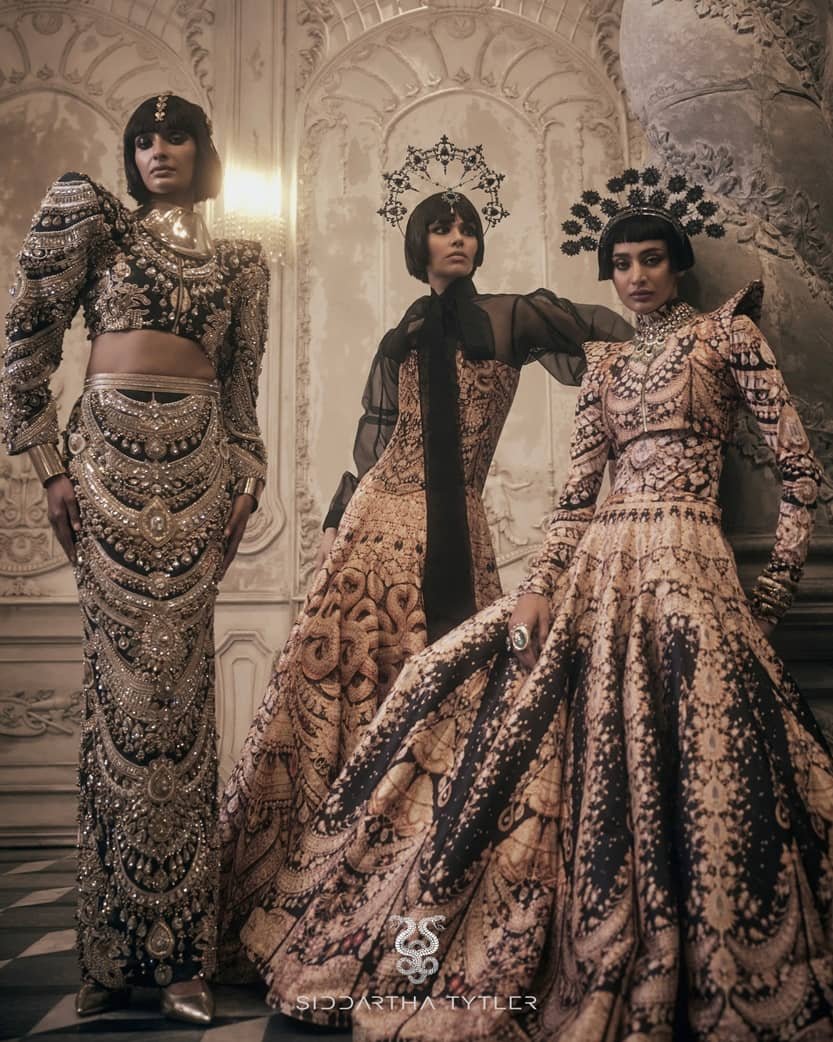
The palette was disciplined even as the embellishment was not: gold, black and ivory, three shades that lend the collection its distinctive visual character. The silhouettes included structured corsets, dramatic gowns, intricately designed sherwanis and sweeping gowns, all characterised by exaggerated proportions.
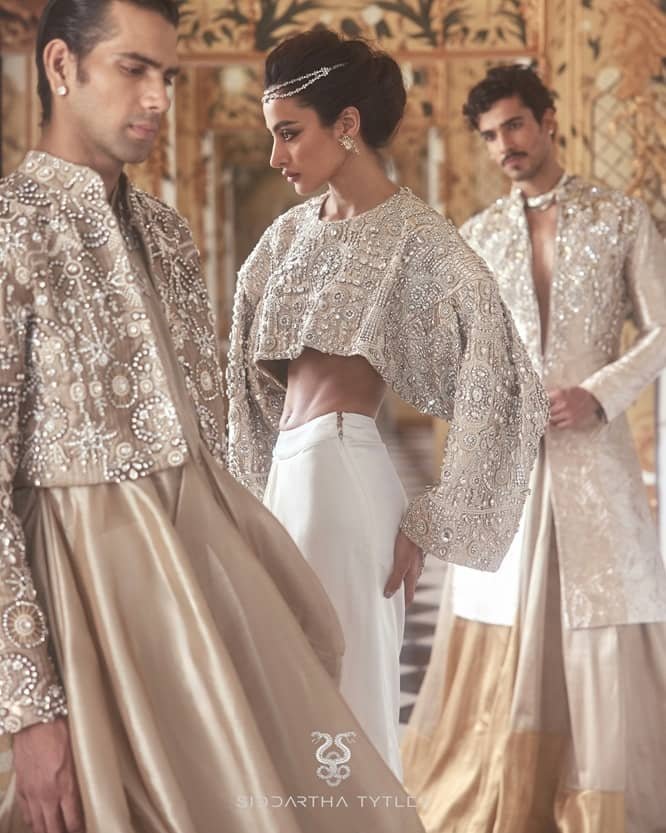
The craftsmanship drew directly on Indian tradition. The collection incorporated embroidery techniques such as Parsi Gara, gota patti and zari work, fused with contemporary touches including digital prints and mixed-media embellishments. The garments were made from luxurious materials including organza, georgette, velvet and raw silk.
The collection’s argument is that tradition and spectacle are not opposites — the most Indian thing about it is also the most extravagant.
Menswear and Womenswear
In menswear, the familiar vocabulary of sherwanis, bandhgalas and kurtas became the foundation for a more elaborate design language, heavily embellished and cut with the exaggerated proportions that run through the collection.
Womenswear moved between lehengas, saris, anarkalis, sculptural separates, panelled dresses and sweeping gowns — the full range of Tytler’s couture, held together by the gold, black and ivory palette and the dense surface work that has long been his signature.
Tytler has described his aim as creating pieces that are not only visually striking but also rich in cultural heritage — clothes that carry the essence of Indian fashion while refusing to be quiet about it. It is a philosophy he has held since his early shows: he has said he does not follow trends, he makes his own.
Across both menswear and womenswear, the through-line is the same: heritage craft, worn at full volume.
A Designer Who Never Left the Stage
Tytler’s 25 years have included some of Indian fashion’s most theatrical moments — from his ‘Caligula’s Feast’ showcase at India Couture Week, inspired by the Roman emperor, to his ‘TRIFECTA’ couture showcase in 2025, which marked 24 years with three acts inspired by the Holy Trinity. His work has been worn by Bollywood stars, and he has said the craziest moment of his career was Beyoncé wearing one of his outfits during lockdown.
The anniversary show arrives in a year when Indian fashion’s global profile has rarely been higher, with Indian designers and craftspeople increasingly visible on international runways and red carpets — a moment in which a designer marking 25 years of maximalist Indian couture can fairly claim to have helped build the stage he is standing on. Matthieu Blazy was named Designer of the Year at the 2026 Belgian Fashion Awards, in a season when fashion’s biggest honours have gone to designers with a strong point of view.
The ‘UNAPOLOGETIC’ show was a statement of survival as much as style: a designer who has spent a quarter-century refusing to tone his work down, celebrating by turning the volume up.
What Happens Next
The collection is expected to be available through Tytler’s Delhi studio and stores, with prices for his couture pieces typically starting at around Rs. 15,000 for simpler pieces and rising sharply for fully hand-embroidered couture. What the anniversary show has already done is reassert Tytler’s place in Indian fashion’s first rank — and remind a new generation of the models and the maximalism that made it.
By The BNN Media
The Best News Network
News Beyond the Borders