 By
Two bridges, two capitals, two nights. Ukraine has crippled the crossing Vladimir Putin calls his flagship project, and Russia has answered by hitting the crossings that hold Kyiv together — and both sides did it with one eye on a meeting in China on Thursday that neither of them will attend as equals.
By Shoaib Khan
Chief Journalist | The BNN Media – The Best News Network
News Beyond the Borders
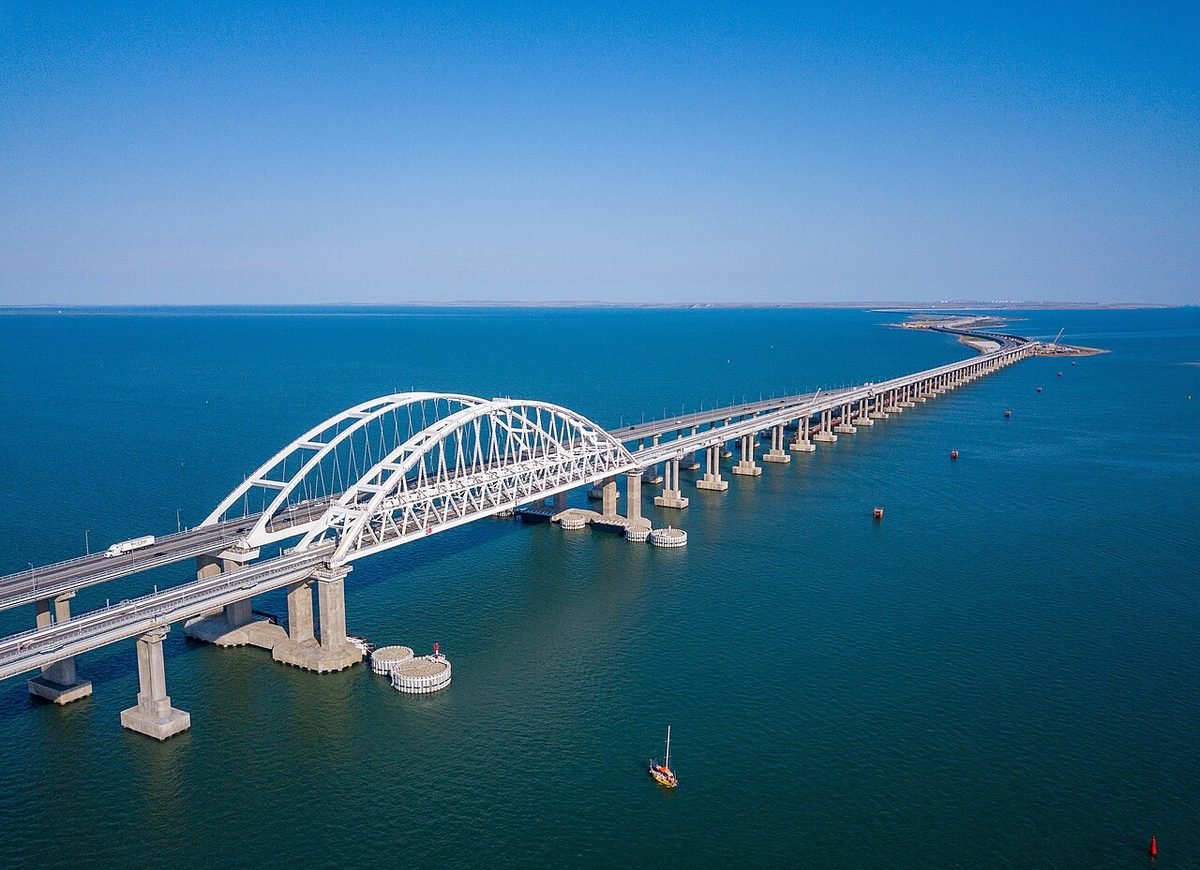
KYIV, Ukraine — Ukraine struck the bridge linking Russia to occupied Crimea for a second night running on Tuesday, 17 November, shutting it down, while Russia hit two major bridges in Kyiv, in the latest wave of attacks ahead of a summit on Thursday, 19 November in Shenzhen, China, between Presidents Xi Jinping, Donald Trump and Vladimir Putin. Ukrainian drones and missiles destroyed the central road section of the 19-kilometre (12-mile) bridge across the Kerch Strait, and videos and images posted on X by President Volodymyr Zelensky and verified by Reuters showed the bridge’s main road arch had crumbled into the sea.
The Second Night: A Span in the Sea
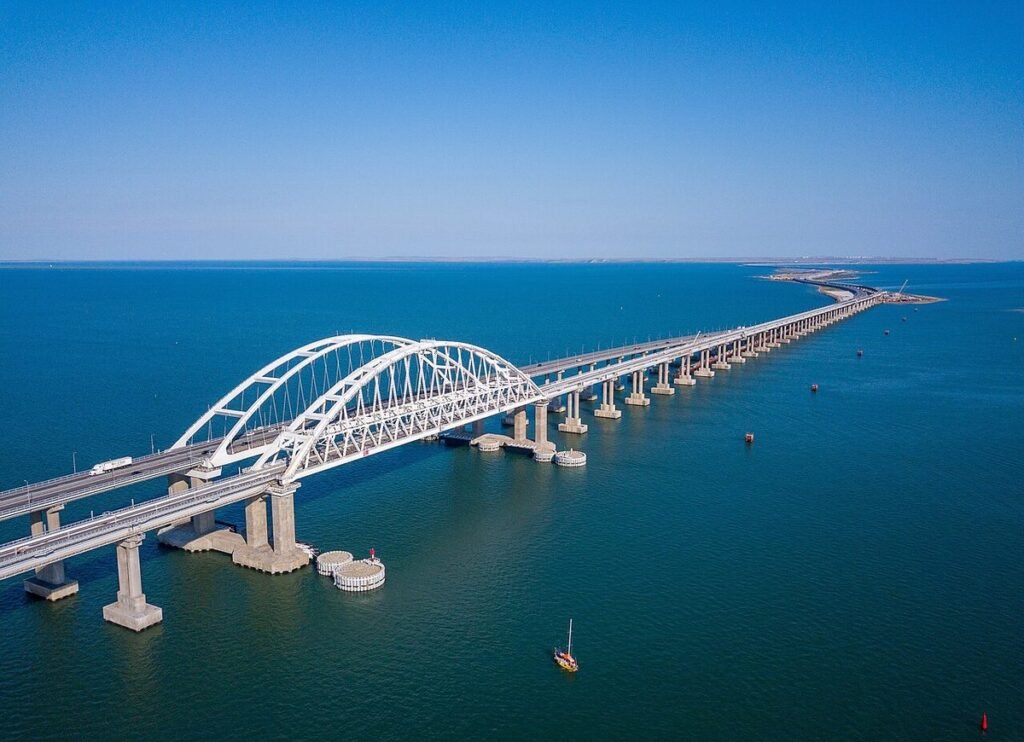
The strike came shortly after midnight local time on Tuesday, a day after a first attack on Monday night had targeted an arch over the bridge’s central section and halted traffic for almost 17 hours from 23:54 on Monday. This time the damage was far worse. Ukraine’s general staff said an arch and a span of the bridge’s road section had collapsed into the Kerch Strait, cutting the road link, while the railway line was still standing but its arch was damaged. Photographs taken on Tuesday suggest that a 227-metre road arch span fell into the strait; the arch alone weighs 5,500 metric tons, more than half the weight of the Eiffel Tower, according to Le Monde.
Sergey Aksyonov, the Russian-installed governor of Crimea, confirmed the attack on Telegram. “The enemy has once again attacked the Crimean Bridge. At the moment, traffic has been suspended,” he wrote. He said two people were killed and road traffic had been suspended; rail traffic partially resumed after a pause. Russia’s transport ministry said experts were assessing the damage, and a government commission led by Deputy Prime Minister Marat Khusnullin met on Tuesday to decide on repairs and alternative routes.
Zelensky called the operation “unprecedented” and said it was carried out by the Security Service of Ukraine, the SBU, together with all of Ukraine’s forces. “Russia strikes our infrastructure every day, including bridges,” he said. “We are … reminding Russia that war will always return to where it began.” He said the strike followed a long campaign that methodically destroyed Russian air defences, radar systems and electronic warfare capabilities, using domestically produced drones and ballistic missiles, and described it as the seventh stage of an operation carried out over several weeks. The SBU said it was its fourth strike on the bridge.
The Kremlin promised the bridge would be rebuilt. “There is, of course, no doubt that the bridge will be restored,” Putin’s spokesman Dmitry Peskov said, adding that a repair plan would be prepared, making it “even better than before”. Russian officials, quoted by Reuters, insisted the damage was only minor and would be quick to sort out. Military analysts were less sure: Finnish analyst Emil Kastehelmi wrote on X that “the road bridge won’t be repaired during this war”, adding that “Ukraine has achieved a victory with both concrete and symbolic implications.”
The pictures tell the story the officials will not: a yawning gap where the road used to run, and a flagship project in the water.
Why This Bridge Matters
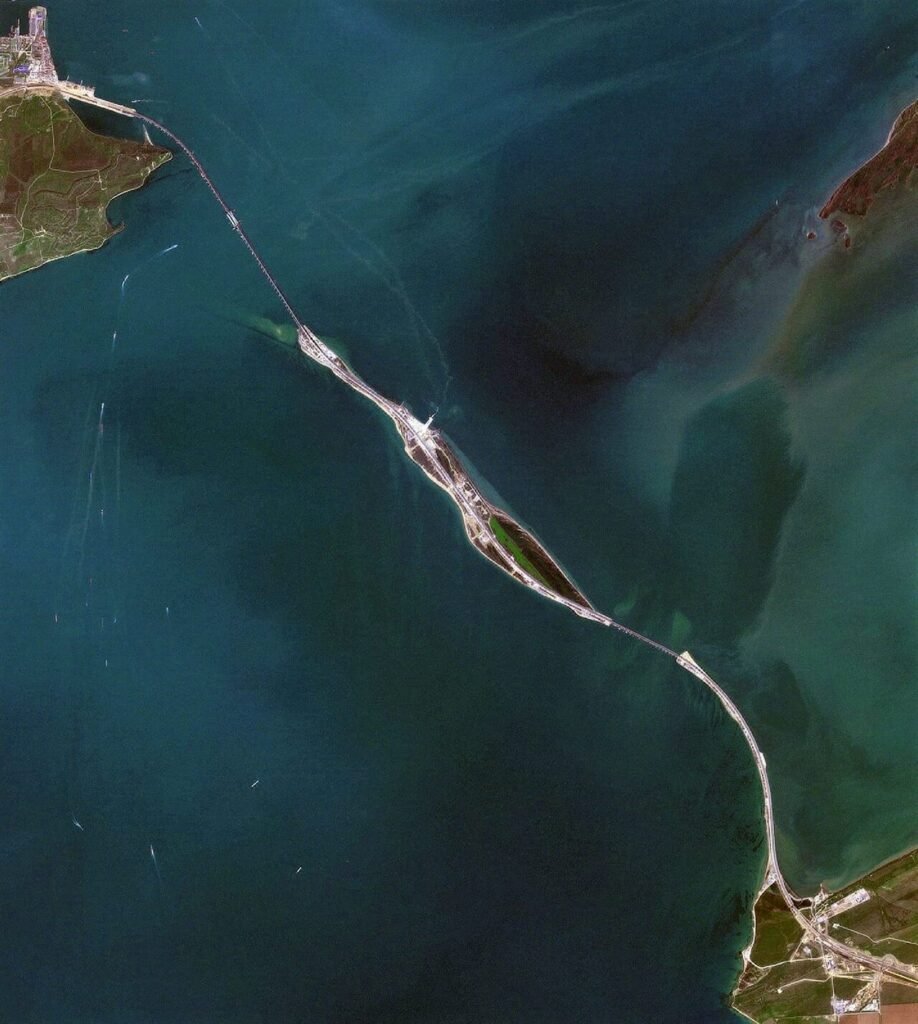
The bridge — officially the Crimean Bridge, also called the Kerch Bridge — is the only direct road and rail link between Russia and Crimea, the Ukrainian peninsula Russia seized and annexed in 2014. Putin inaugurated the road bridge in May 2018, driving a truck across it himself, and the rail bridge followed in December 2019. At 19 kilometres it is the longest bridge in Europe, and it has been both a supply route and a symbol: the physical proof, in concrete and steel, of Russia’s claim to the peninsula.
It has been attacked before. A truck bomb in October 2022 killed four people and limited the bridge’s capacity for months; in July 2023 a section of road bridge was destroyed and a couple crossing by car were killed. But this week’s attack is the most serious yet: the first time a main span has been brought down.
Its military value has faded since those earlier attacks — Russian forces now rely more heavily on a land corridor running through parts of eastern and southern Ukraine captured since the full-scale invasion began in 2022. Its symbolic value has only grown. That is why the timing matters, and why it was chosen now: two days before Putin sits down with Trump and Xi, Ukraine has shown it can still hit the target Putin cares about most, in the place he can least afford to lose it.
Russia’s Answer: Kyiv’s Bridges
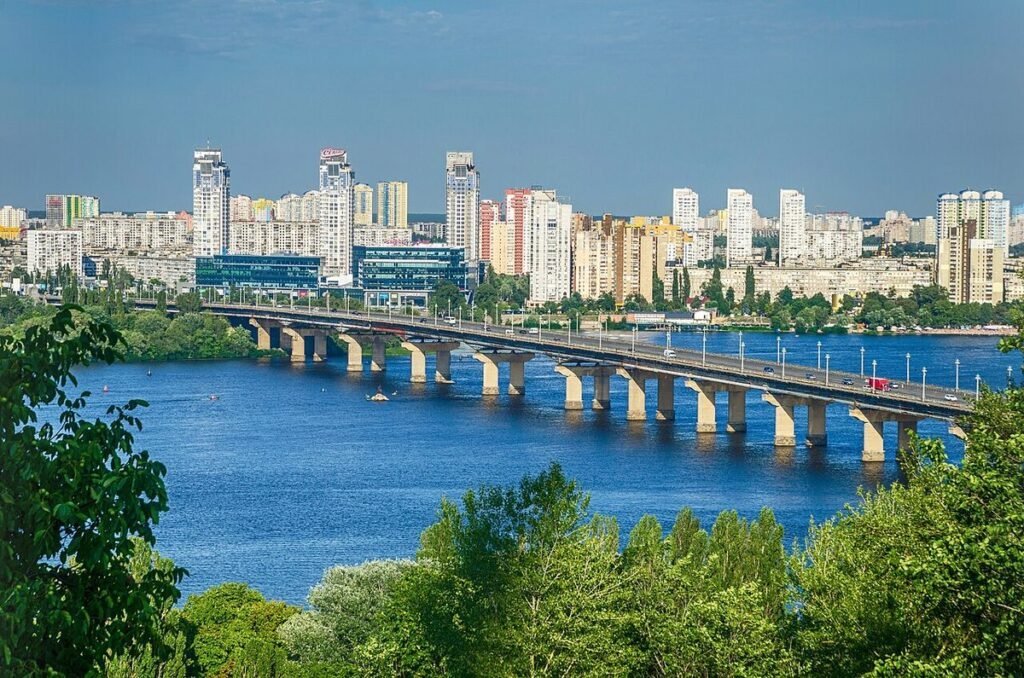
Hours earlier, Russia had struck back at the same kind of target. Kyiv’s mayor, Vitali Klitschko, said Russian ballistic missiles hit the city’s Northern and Southern bridges, two major crossings over the Dnipro River, closing both and partially damaging the metro system. The attacks caused power and water outages and disrupted heating in parts of the capital. Moscow later confirmed the strikes; Reuters said it could not immediately independently confirm the reports.
The Kyiv strikes were part of a wider Russian barrage. Russia said it shot down 1,441 Ukrainian drones over 22 regions in the overnight attack — which Russian state media called Ukraine’s biggest drone attack yet, surpassing the previous record of 1,336 set on Monday. Moscow’s mayor, Sergei Sobyanin, said around 800 Ukrainian drones had flown towards the surrounding Moscow region, 321 of which had been brought down. Ukraine said it had hit a refinery and petrochemical complex in Salavat, in Russia’s Bashkortostan region.
Zelensky has repeatedly said Ukraine proposed de-escalation steps to Russia and heard only refusals. “We have repeatedly proposed de-escalation steps to Russia, and to all proposals we heard only loud refusals,” he said. “Russia strikes our infrastructure every day, including bridges, in Zaporizhzhia, Dnipro, Kyiv and the Odesa region.”
Washington Criticises Kyiv — and Europe Pushes Back
The bridge strikes landed in the middle of an open argument among Ukraine’s own allies. At a meeting of the Ukraine Defence Contact Group at NATO headquarters in Brussels on Tuesday, the US Under Secretary of Defense for Policy, Elbridge Colby, criticised Ukraine’s “deep strikes” against Russia — attacks far behind the front line — saying they had not worked.
“Our assessment is that such strikes have not been effective in driving an end to the war, nor do they contribute to blunting Russia’s advances on the front line,” Colby told the gathering. “Such strikes, especially those that target civilian infrastructure such as Wildberries, have actually probably hardened the Russian public’s resolve and the Kremlin’s own willingness to escalate.” He did not mention the Kerch bridge strike directly.
The response from Europe was swift and public. Germany’s defence minister, Boris Pistorius, said criticising strikes of that kind was “quite a stupid thing” to do. “Instead of criticizing that, we should rather criticize and talk about the terroristic strikes every night and every day on … energy, water, and heating infrastructure in Ukraine. This is kind of terrorism,” he said. Britain’s defence minister, Wes Streeting, said the Ukrainian strikes had “helped to degrade Putin’s war machine, buying time and saving lives”. NATO Secretary General Mark Rutte said the bridge strike was a legitimate defensive act, and that Ukraine’s right to defend itself included attacking logistical hubs.
Zelensky, addressing the same gathering, urged Kyiv’s backers to send air defences — including US Patriot missiles — without delay. Ukraine’s defence minister, Yevgeniy Khmara, said Kyiv had the right to defend itself however it wants and warned Moscow it would retaliate “tenfold” for the Kremlin’s attacks. Colby’s criticism follows earlier pressure from Trump himself, who has previously pressed Ukraine to halt strikes on Russian oil refineries.
The argument is not about one bridge. It is about whether Ukraine’s long-range campaign is winning the war, prolonging it, or simply giving Russia a reason to escalate — and Kyiv’s allies no longer agree on the answer.
The Talks Behind the Strikes
The fighting has not stopped the talking. Zelensky said on Monday that Ukraine had held new online talks with US presidential envoys Steve Witkoff and Jared Kushner, as well as European representatives, on the prospects of ending the war. Kushner said progress had been made towards an agreement, though important challenges remained.
Those talks follow the first direct US-brokered round between Ukrainian and Russian representatives in nine months, held in Abu Dhabi on Tuesday and Wednesday, 10–11 November, which ended without a breakthrough but produced an agreement on a prisoner exchange involving more than 1,000 people. The bridge strikes came despite those talks, not because they had broken down — both sides are fighting to improve their position before the next round, and before Thursday.
Thursday in Shenzhen
On Thursday, 19 November, Presidents Xi, Trump and Putin are due to meet in Shenzhen, China, in the first-ever trilateral summit of the three leaders, held on the sidelines of the APEC leaders’ meeting. The Ukraine war is expected to be on the agenda: Trump told reporters, “We’ll talk about my favourite subject, Ukraine.”
The timing of the bridge strikes is no coincidence. An officer involved in the Ukrainian operation told The Times it had been “planned as a symbolic gesture before the meeting of Trump, Putin and Xi, to show that Putin is weak”. The operation, according to Ukrainian military sources cited by The Times, involved missile troops and elite drone pilots from the 7th Deep Strike Centre, known as Magyar’s Birds, together with the 1st Special Operations Brigade of Unmanned Forces, the SBU, the navy and special operations forces, using Flamingo and Neptune cruise missiles and Palyanytsya drone missiles. Those operational details come from Ukrainian military sources and have not been independently confirmed.
For Kyiv, the message of the week is that it will not wait quietly while three presidents discuss its future. For Moscow, the message is that the war it started can now reach the bridge it built to celebrate its conquest. And for Washington, the argument in Brussels shows the harder problem: even among allies, there is no agreement on what Ukraine should be allowed to hit, or what hitting it achieves.
What to Watch
- Russia’s official damage assessment for the Kerch bridge, and any timeline for reopening road or rail traffic — and whether shipping through the Kerch Strait can resume.
- Whether the Northern and Southern bridges in Kyiv reopen, and how long power, water and heating disruptions last in the capital.
- The Shenzhen summit on Thursday, 19 November: what Trump, Xi and Putin say about Ukraine, and whether anything agreed there changes the fighting.
- The next round of US-brokered talks, and whether the European governments now involved — Britain, France, Germany, Italy and Poland — are given a formal seat at the table.
Two bridges were hit in two nights, and a third meeting is two days away. The war is being fought on the ground, in the air — and now, quite deliberately, in the shadow of a summit.
By Shoaib Khan
Chief Journalist | The BNN Media – The Best News Network
News Beyond the Borders