 By
A nine-month-old baby has already died of suspected hypothermia in a tent in Gaza. Now the United Nations is warning that more children will die of cold this winter unless shelter and supplies are allowed in — and four foreign ministers have told Israel to “stop the delays now”.
By Faseeh Ur Rehman
Senior Journalist | The BNN Media – The Best News Network
News Beyond the Borders
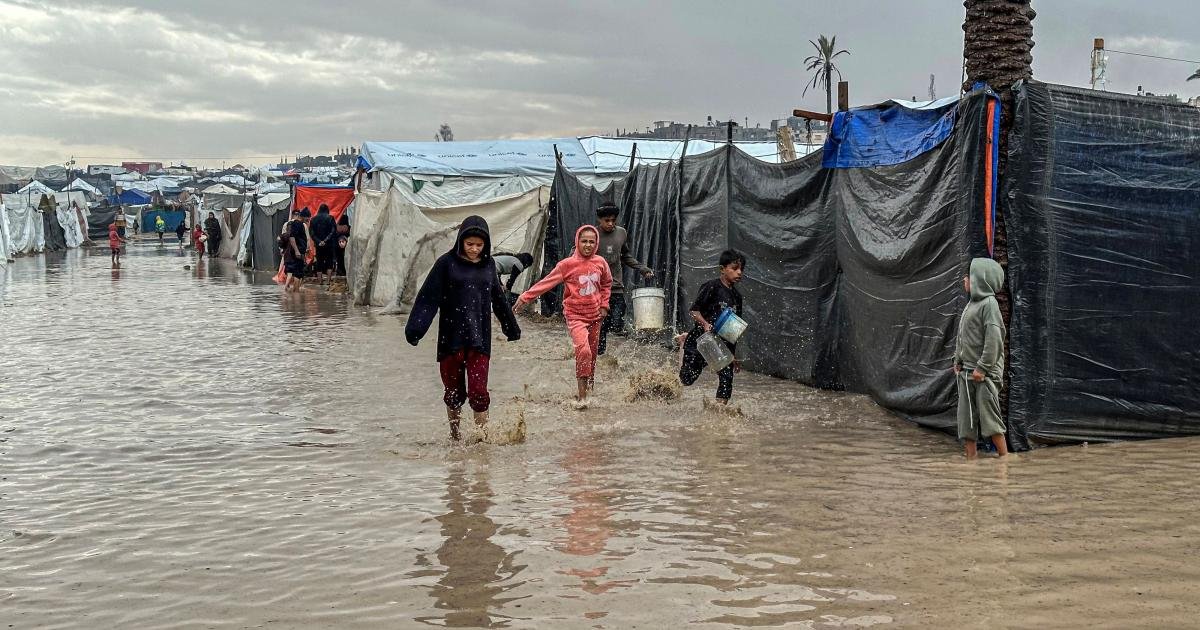
GENEVA, Switzerland — The United Nations has warned of further deaths from hypothermia in Gaza as winter sets in, after a nine-month-old baby living in a tent died from suspected cold last week and heavy rain flooded tens of thousands of makeshift shelters. More than 1.7 million people remain displaced across the territory, and about 1.4 million face acute hunger, the UN’s food and migration agencies said in a briefing in Geneva on Tuesday, 17 November.
A Baby’s Death, and a Warning
“Without proper shelter, without critical relief items, then hypothermia deaths will occur,” Karl Baker, head of the International Organization for Migration’s (IOM) Gaza programme, told journalists in Geneva. “It’s unacceptable to have hypothermia in the modern world.”
Children are particularly vulnerable, Baker said, because they lose body heat more quickly. The baby’s death is believed to be the first cold-related death of the current winter — and the agencies fear it will not be the last. Respiratory illnesses are already rising, according to UN agencies and Gaza’s health authorities.
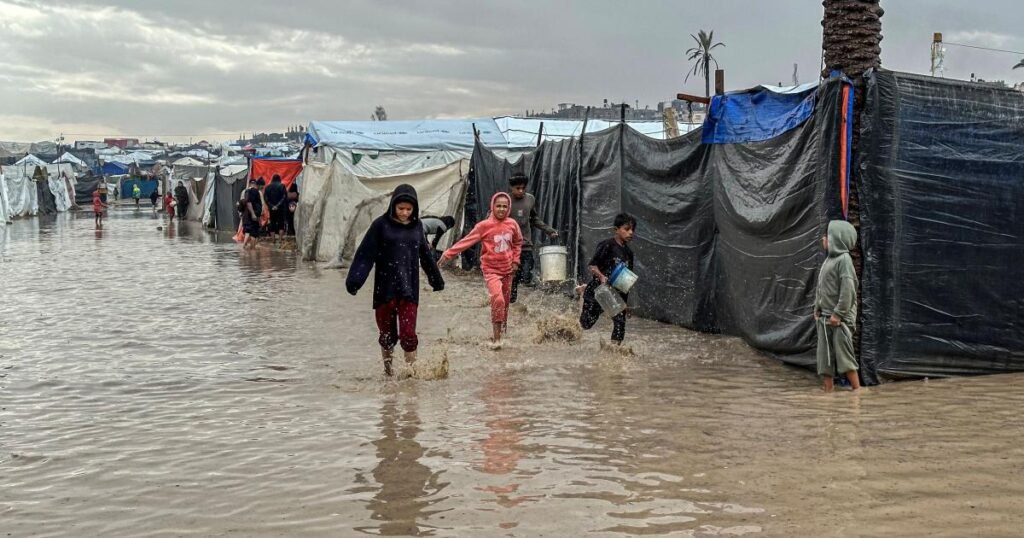
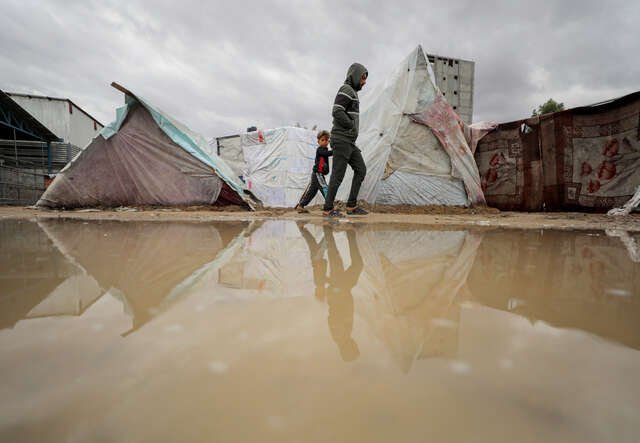
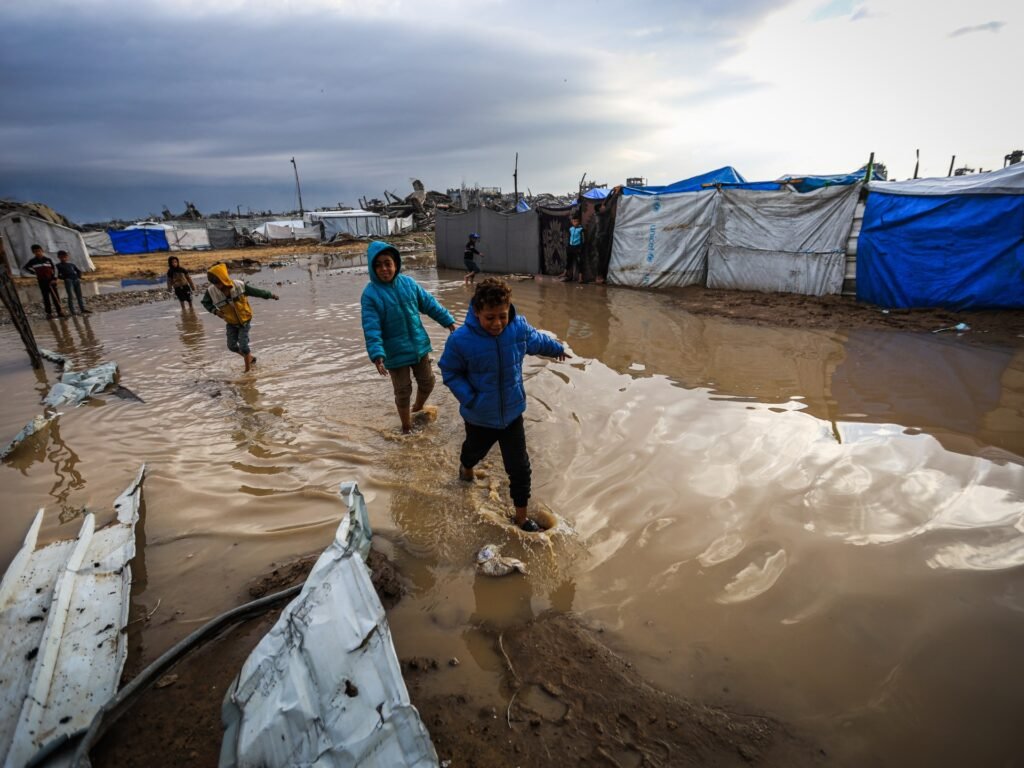
The warning comes after the first heavy rainfall of the winter season, which began late on Friday, 6 November and flooded displacement sites across the territory. “After just one day of rain, tens of thousands of shelters were damaged or destroyed,” Baker said.
A baby has already died of cold in a tent. The UN’s warning is blunt: without shelter and supplies, more will follow.
The Storm’s Toll
The rain did more than soak tents. At least five people were killed when a sandbank collapsed just over a week ago, and humanitarian partners reported that two children had died in fires started accidentally by families cooking inside their tents in an attempt to stay warm.
According to the UN Office for the Coordination of Humanitarian Affairs (OCHA), the first storm damaged more than 40,000 family shelters, including over 9,000 destroyed beyond repair, based on reports received by 9 November that were still awaiting verification. OCHA’s situation report of 13 November recorded about 473 alerts between 6 and 9 November, indicating that more than 46,000 households — around 226,000 people — might have been affected.
The damage struck at the heart of daily survival. Shaun Hughes, the World Food Programme’s (WFP) country director for Palestine, told the Geneva briefing that floodwater and sewage had destroyed food stocks that displaced families were keeping inside their tents, while cooking gas and firewood are unavailable or unaffordable.
“Most people burn rubbish to cook their food. Now even the rubbish is wet,” Hughes said.
Hunger on Half Rations
The flooding threatens to reverse recent, fragile improvements in food security — improvements the agencies say were sustained mainly by humanitarian aid rather than any recovery in livelihoods, markets or local food systems.
In the tented camps, WFP used to provide one hot meal a day. “Now it’s one hot meal every two days,” Hughes said. The agency has cut support for 500,000 people per month as funding has tightened.
The scale of need is immense. Nearly two million people — 1.98 million — require shelter assistance, according to the UN’s humanitarian reporting, in a territory of about 2.1 million people, most of them displaced and squeezed into less than 40 per cent of Gaza’s land. More than half of the territory’s total area is under Israeli restrictions, UN maps show.
“When you’re in Gaza, it does not feel like a ceasefire,” Hughes said. “Israeli military control across nearly 70 per cent of Gaza means that people have almost no space to grow their own food. Fishing in the sea is prohibited and also life-threatening. Unemployment is over 80 per cent, so without humanitarian assistance, people have little or no alternate means of survival.”
This is the fourth winter of displacement for Gaza’s families. UN Women told the same briefing that one in four households in Gaza is headed by a woman, and that even before the floods, those households were more likely to be living in inadequate shelters. Widows and women whose husbands have been forcibly disappeared, severely injured or remain missing face “unimaginable hardship, often alone”, the agency said.
Tents Held at the Border
The most immediate problem is not a shortage of tents — it is getting them in. Baker told the briefing that more than 100,000 tents are standing by for delivery from Egypt, with flows hindered by crossing closures and lengthy Israeli security checks. He described meeting a drenched family sheltering beneath sagging, worn-out tarpaulins. “Gaza is turning into one large IDP camp,” he said. “It ranks as one of the worst I’ve walked through.”
The foreign ministers of Australia, Canada, Italy and the United Kingdom took up the same point in a joint statement on Sunday, 15 November, urging Israel to “stop the delays now” and allow “immediate, rapid and unimpeded humanitarian access throughout Gaza”. Their statement said 150,000 tents and other vital supplies are being held at the border and prevented from entering Gaza, and called for dual-use items necessary for humanitarian operations and early recovery to be granted entry before it is too late.
“This situation is entirely reversible — and there is still time to act before the winter fully sets in,” the four ministers said, calling on all parties to implement the Comprehensive Plan for Gaza, respect the ceasefire that took effect on 10 October 2025, and meet their obligations under international humanitarian law.
Israel’s military agency that coordinates aid, COGAT, says it has a proactive “winterization plan” and that more than 93,000 tents and over 8,600 trucks of winter supplies have entered the territory — figures that have not been independently verified. The European Union issued a similar statement on Saturday, 14 November, calling for humanitarian access to be opened up.
What the Agencies Say They Need
IOM says the most effective immediate protection is better management of the displacement camps. Humanitarian teams have worked for months to prepare sites for winter — digging drainage channels, reinforcing pathways and repurposing flour bags as sandbags to limit flooding. But those efforts require at least $9 million in the coming months for flood prevention, fire safety, heating points, lighting and emergency site improvements, and basic tools such as shovels, sandbags and nails are urgently needed.
The funding gap is far larger than that. IOM has a $173 million funding shortfall for its winter shelter programmes, Baker said.
Baker also called for robust structures such as caravans and prefabricated housing to be funded and allowed in — and he described the rules that keep even tents out. Securing entry for a tent can depend on strict criteria, including the diameter of its central pole: “Usually anything under 38 millimetres is okay; anything above, it’s usually deemed as not acceptable,” he explained. “It is not a statement of dual use, it is just that this tent at this time is not allowed to enter Gaza… We don’t get the specifics.”
Humanitarian agencies say they work closely with COGAT to ensure equipment entering Gaza meets Israel’s security requirements — but that clearance takes a long time and is heavily bureaucratic. IOM is urging member states to use their influence with the Israeli authorities to secure the opening of additional crossing points and the immediate and predictable entry of humanitarian supplies, including more robust and longer-lasting shelter equipment.
- More than 1.7 million people remain displaced in Gaza
- About 1.4 million face acute hunger
- 1.98 million require shelter assistance
- More than 40,000 family shelters damaged by the first winter storm; over 9,000 destroyed beyond repair
- 150,000 tents held at the border, according to the four foreign ministers
- $173 million — IOM’s funding shortfall for its winter shelter programmes
A Winter That Has Only Just Begun
The first storm has passed, but winter in Gaza has only just begun — and the shelters that survived the first rain are the same worn-out tents and tarpaulins that failed in previous winters. The UN’s agencies have set out what is needed: tents and sturdier shelter allowed in, money to prepare the camps, and crossings opened in time.
“Anything that can come in at any time, we just highly appreciate it and from any source; but of course, it needs to be durable and that’s what we’re looking for in order just to get through this winter,” Baker said.
The tents exist. The money does not — and the cold, the UN warns, will not wait for either.
By Faseeh Ur Rehman
Senior Journalist | The BNN Media – The Best News Network
News Beyond the Borders