By
Pakistan has a man in orbit at last. Wing Commander Muhammad Zeeshan Ali, a 40-year-old Pakistan Air Force pilot, rode into space aboard China’s Shenzhou-24 spacecraft on Wednesday morning — the first Pakistani ever to reach orbit, and the first foreign astronaut to visit China’s Tiangong space station.
By Salar Khan
Reporter | The BNN Media – The Best News Network
News Beyond the Borders
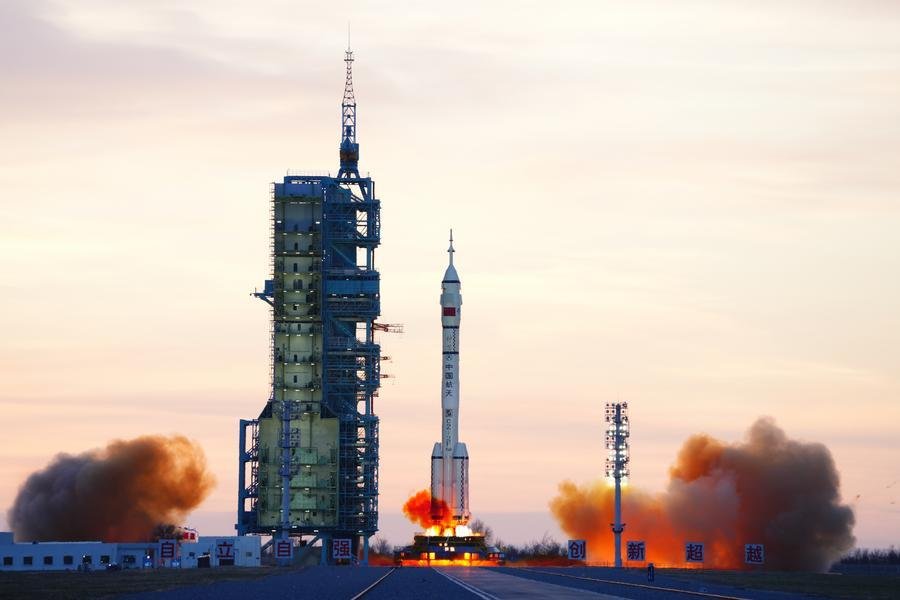
JIUQUAN, China — A Long March-2F rocket carrying the Shenzhou-24 spacecraft lifted off from the Jiuquan Satellite Launch Center in northwest China at 8:18 am Beijing time (5:18 am in Pakistan) on Wednesday, 25 November 2026. About ten minutes later the spacecraft separated from the rocket and entered its designated orbit, and the China Manned Space Agency (CMSA) declared the launch “a complete success.”
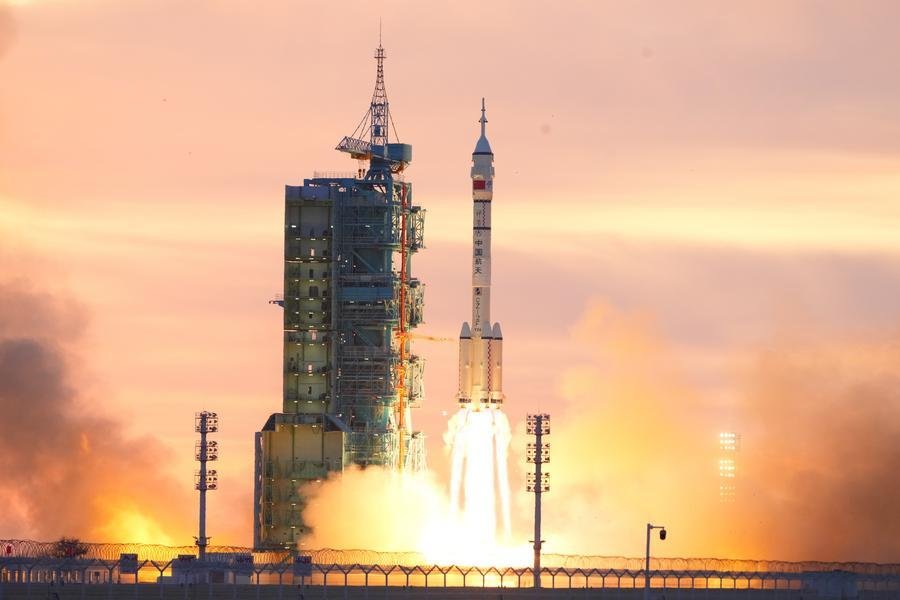
A Dawn Liftoff from the Gobi Desert
The launch came at first light over the Gobi Desert, where the Long March-2F — China’s only human-rated launch vehicle — stood on the pad at Launch Site 91. Minutes after liftoff, the three crew members were seen on a live feed broadcast by state-run CCTV, flipping through a manual as the spacecraft climbed. CCTV reported that the crew were in good condition.
The mission is the 18th crewed Chinese spaceflight and the 12th crewed mission to the Tiangong space station. It is also the 680th flight of the Long March carrier rocket series, a milestone China noted as the rocket carried its first foreign passenger.
For Pakistan, a country with no launch vehicle or crewed spacecraft of its own, the flight is its first entry into human spaceflight.
Docking with Tiangong
Shenzhou-24 did not have long to wait for its destination. After a fast, automated rendezvous, the spacecraft docked with the front port of Tiangong’s Tianhe core module at 11:56 am Beijing time (8:56 am in Pakistan) — about three and a half hours after liftoff.
The three astronauts were then to enter the Tianhe module, where the Shenzhou-23 crew was waiting to receive them. The handover is an unusual one: while most crew rotations simply swap one team for another, this mission will leave one Shenzhou-23 astronaut behind.
The launch went exactly to plan — and by mid-morning, Pakistan’s first astronaut was aboard the station.
The Crew: A Commander, a First-Timer and a Trailblazer
The three-man crew pairs deep experience with two firsts. Mission commander Tang Hongbo is on his third trip to orbit, having previously flown on Shenzhou-12 and Shenzhou-17, making him the first Chinese astronaut to visit Tiangong three times. Flight engineer Wu Yi is flying to space for the first time.
And then there is the third seat — the one that made history. Muhammad Zeeshan Ali, a Pakistan Air Force pilot selected through a cooperation agreement between China and Pakistan, is flying as a payload specialist, a role built around scientific experiments rather than piloting the spacecraft. His backup, named before the launch, was Khurram Daud.
In a small but telling detail, the mission’s crew patch carries three white chameli flowers — the national flower of Pakistan — woven into its design.
Three men went up; only one of them carried the hopes of an entire nation that had never sent anyone to space before.
What Zeeshan Ali Will Do in Orbit
Ali’s stay on Tiangong will be short — five to ten days, or about a week — but it is packed with work. According to the CMSA, more than 90 scientific experiments and technology tests are planned for the Shenzhou-24 mission, covering space life sciences, space material science, microgravity fluid physics, combustion science, fundamental physics, space medicine and new space technologies.
Four of those projects are joint China–Pakistan work in biotechnology and materials, developed by universities in Pakistan. Ali will also conduct an in-orbit experiment on photosynthetic cyanobacteria, the CMSA spokesperson Zhang Jingbo said at Tuesday’s pre-launch press conference.
The mission at a glance:
- Launch: Wednesday 25 November 2026, 8:18 am Beijing time (5:18 am PKT), Jiuquan Satellite Launch Center
- Rocket: Long March-2F (Y24)
- Spacecraft: Shenzhou-24, docking with Tiangong’s Tianhe module at 11:56 am Beijing time
- Crew: Commander Tang Hongbo, flight engineer Wu Yi, payload specialist Muhammad Zeeshan Ali
- Ali’s stay: 5 to 10 days aboard Tiangong, returning on Shenzhou-23
- Experiments: More than 90 planned, including four China–Pakistan cooperative projects
A week in orbit is short — but for Pakistan’s scientists, the experiments Ali carries home in his data will last far longer.
Seven Months of Training in Beijing
Ali did not arrive at the launch pad by chance. He trained for seven months in Beijing to prepare for the flight, undergoing intensive Chinese-language classes, learning Chinese songs and reading Chinese poetry. He also practised calligraphy and played table tennis alongside his crewmates.
Speaking to reporters on Tuesday, the day before launch, he put the mission in words that travelled quickly back home: “I’m not flying for myself. I carry the name of Pakistan on my shoulder.” He said he was deeply grateful to China for helping Pakistan realise its dream of going into space.
Seven months of language lessons, training and preparation — all for a flight that lasted ten minutes to orbit.
Pride at Home: Pakistan Reacts
The reaction in Pakistan was swift and emotional. Prime Minister Shehbaz Sharif called the flight “a historic first” in a post on X ahead of the launch, thanking Chinese President Xi Jinping and writing: “Pakistan-China friendship is surpassing the heights of the Himalayas, in its journey to outer space.”
President Asif Ali Zardari called the flight a landmark achievement and a moment of immense national pride, quoting Allama Iqbal: “Sitaron se aagay jahan aur bhi hain” — beyond the stars, there are more worlds yet.
Back home, Pakistanis can follow the mission through a new SUPARCO portal, the Mission Hub at astronaut.suparco.gov.pk, which carries a dashboard of the station’s modules, a mission timeline and live tracking of the station over Pakistani cities. Visitors can even download a boarding pass by entering their name and city.
As reported in our pre-launch coverage, the launch had been the moment the whole country was waiting for — yesterday’s report set out how Ali was chosen and what the mission means for Pakistan.
What Comes Next: A Week in Orbit, Then Home
After completing the short joint flight, Ali will return to Earth aboard the Shenzhou-23 spacecraft, alongside two Shenzhou-23 crew members. The other two Shenzhou-24 astronauts, Tang Hongbo and Wu Yi, will stay in orbit for roughly six months.
They will be joined for part of that stay by Shenzhou-23 commander Zhu Yangzhu, who has already spent six months in orbit and will remain aboard Tiangong to complete a year-long stay experiment — the first time a Chinese astronaut has been scheduled to spend a planned year in space, in research aimed at understanding how the human body copes in weightlessness ahead of a planned crewed mission to the Moon.
China is promoting Tiangong — fully operational since late 2022 — as a hub for international cooperation, at a time when the NASA-led International Space Station faces possible retirement by 2030. As Blaine Curcio, founder of Hong Kong-based Orbital Gateway Consulting, told Reuters, the flight “brings prestige, important science and technology know-how, and a level of deeper collaboration and diplomatic goodwill with China.”
So far, China has sent 31 Chinese astronauts and one foreign astronaut into space. On Wednesday, that one foreign astronaut was a Pakistani.
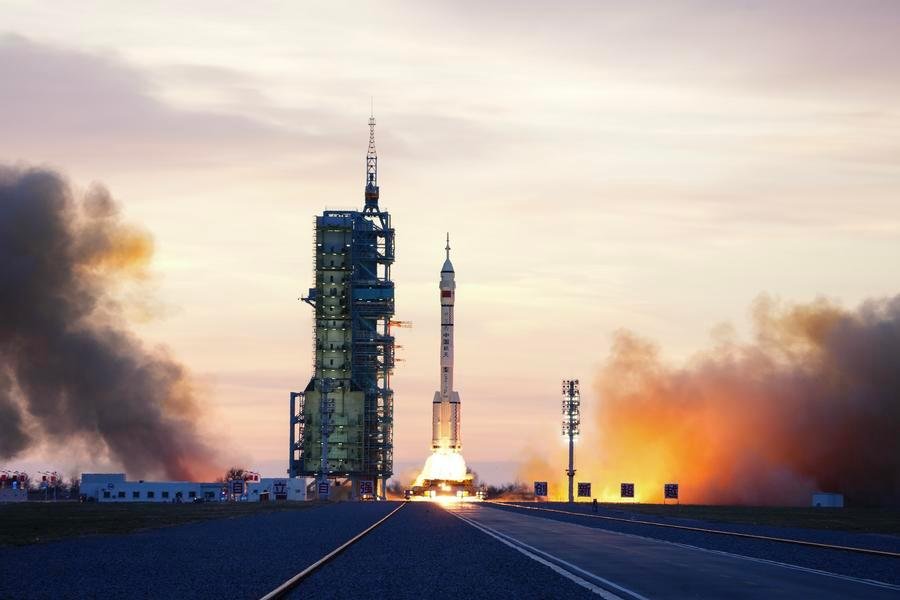
Pakistan waited decades for this morning — and in ten minutes, a PAF pilot from Pakistan became the first foreigner aboard China’s space station.
By Salar Khan
Reporter | The BNN Media – The Best News Network
News Beyond the Borders
Sources: Reuters; China Daily Asia / Xinhua; Nature; China Manned Space Agency; collectspace.