 By
For the first time in its 130-year history, the Venice Biennale let its visitors choose the winners. The public picked an American sculptor working through grief in bronze — and an Indian pavilion built around the idea of home.
By The BNN Media
The Best News Network
News Beyond the Borders
Venice, Italy — The 61st Venice Biennale has named its winners — and this time, the judges were the visitors. American artist Nick Cave has won the Visitors’ Lion for Best Participant, and India’s national pavilion has won the Visitors’ Lion for Best National Participation, the Biennale announced on Wednesday, 25 November, three days after the exhibition closed.
The Public Has Spoken
The awards, announced quietly by press release, are the first in the Biennale’s long history to owe their result to the public rather than to a jury. Under normal circumstances, an independent international jury awards the Golden and Silver Lions for the best national pavilions and the best work in the central exhibition. This year there was no jury to do it — it had resigned months earlier — so the Biennale handed the decision to the people who had actually walked through the show.
The winners were chosen by ticket holders who had visited both of the Biennale’s principal venues, the Giardini and the Arsenale, during the exhibition’s run from 9 May to 22 November. Each eligible visitor received a voting link by email 24 hours after entering the second venue, and voting stayed open for the entire six-and-a-half-month run.
The edition drew a record 714,015 visitors over that period and featured 100 national participations, the most in the Biennale’s history, according to reports. But the Biennale has not disclosed how many of those visitors actually voted, and it will not publish a breakdown of the results — a decision that has itself become part of the controversy.
The audience chose. The audience’s choice was announced. How many of the audience actually voted, nobody outside the Biennale knows.
Nick Cave: Grief in Bronze
Nick Cave — the Chicago-based artist, not the Australian musician of the same name — is best known for his elaborate wearable sculptures, the “Soundsuits”, that cover the body in colour, texture and sound. For Venice he did something very different.
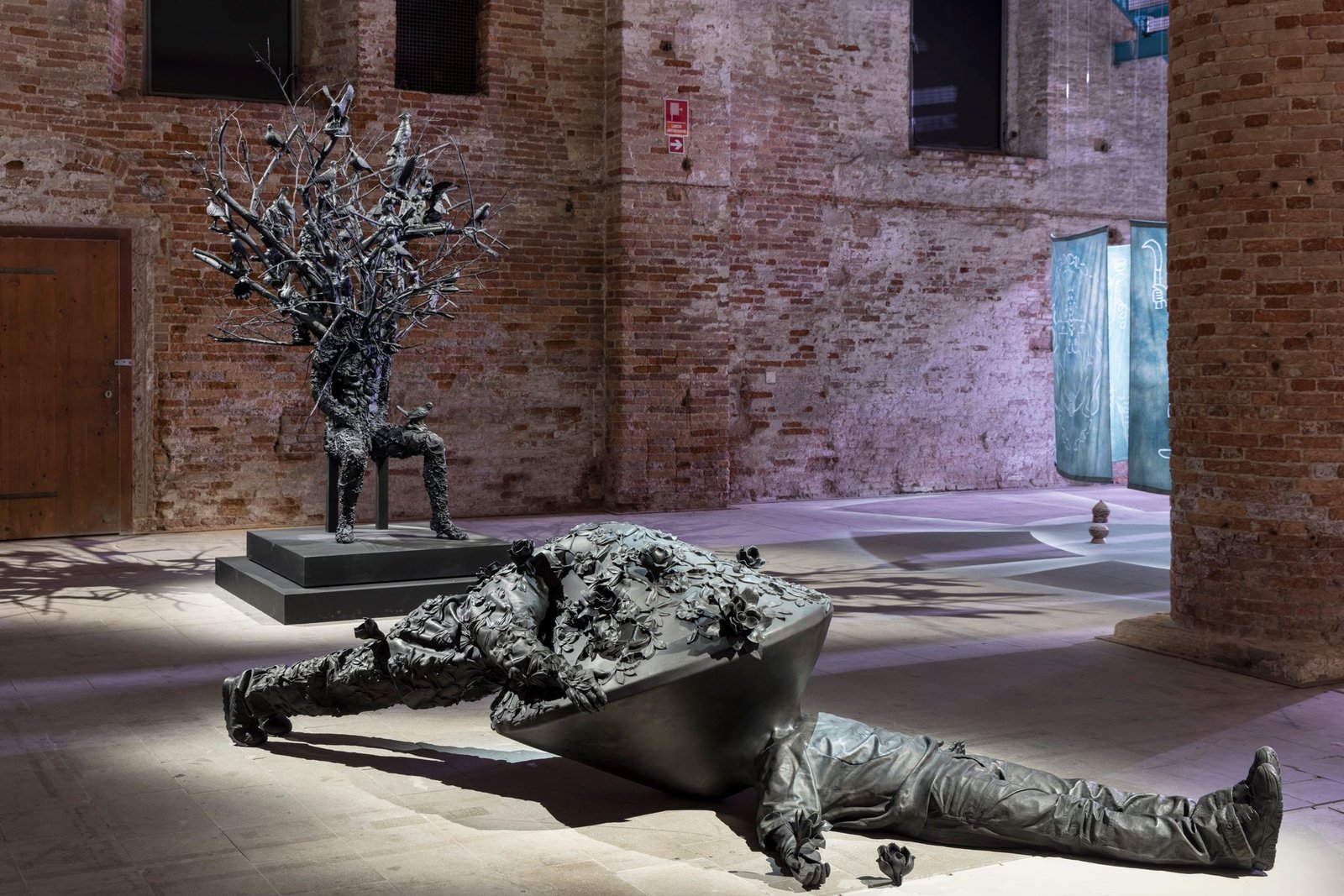
His installation in the Arsenale, part of the central exhibition In Minor Keys, is a suite of seven large bronze works tracing the seven stages of grief, including the 2024 sculpture Amalgam (Origin) and Amalgam (Resuscitation) (2025), in which human forms fuse with branches, gramophones, blooming florals and birds. The works address grief moving toward mourning, rebirth and radical connection.
Speaking to Ocula, Cave said he recognised that global conflicts had shaped the Biennale’s 61st edition and respected the original jury’s decision to resign, but remained grateful to have been selected by the public.
“This project is a distillation of my larger practice that acknowledges the history of violence and oppression [that] Black individuals, as well as all marginalised communities, have and continue to face,” he said. “[It] honors the beauty created by those same communities, as well as [representing] growth towards a different future. It feels apt that works so deeply rooted in this narrative would be selected by the public in this moment.”
A sculptor famous for costumes you can wear won with bronzes you can only stand before — and the public chose the quieter, heavier work.
India: A Pavilion About Home
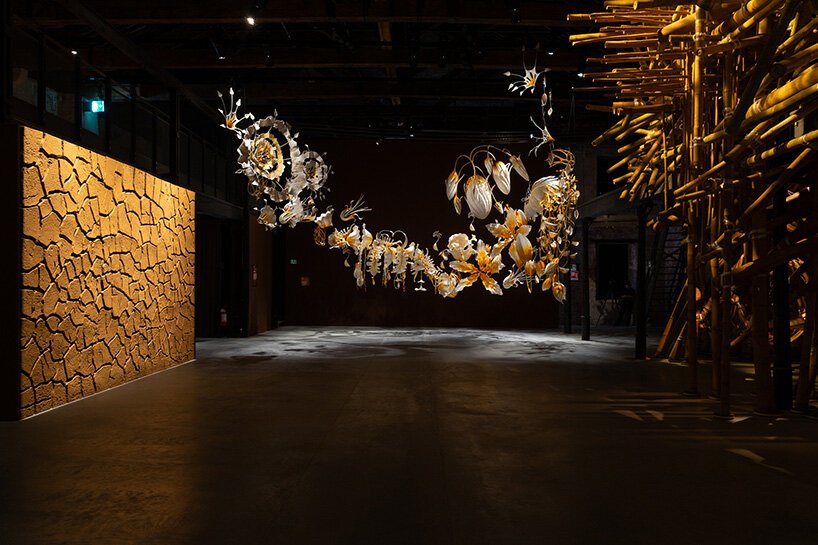
India’s winning pavilion, Geographies of Distance: Remembering Home, occupied the Arsenale and marked the country’s return to the Biennale after a seven-year absence — its first national pavilion at Venice since 2019. It was commissioned by the National Gallery of Modern Art, under India’s Ministry of Culture, and curated by the scholar and curator Amin Jaffer.
Five artists took part — Alwar Balasubramaniam, Sumakshi Singh, Ranjani Shettar, Asim Waqif and Skarma Sonam Tashi — and their installations explored memory, displacement and the changing meaning of home in a country undergoing rapid urban development.
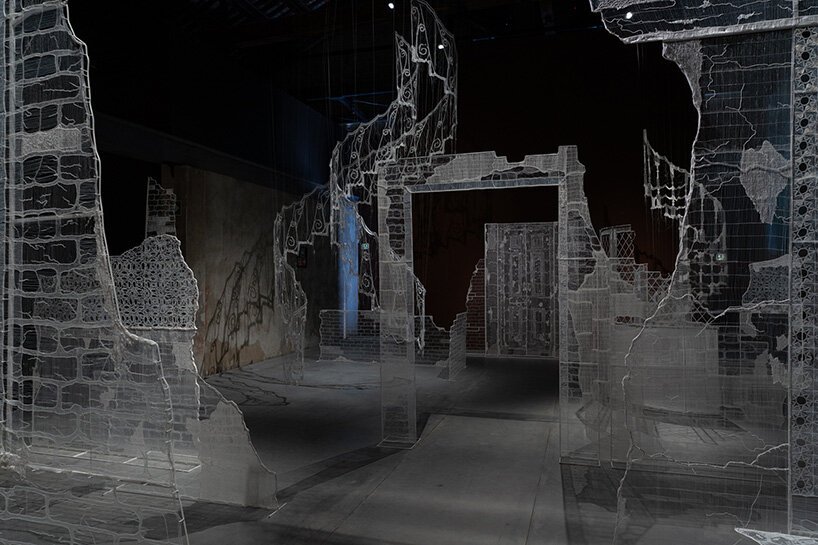
The most talked-about work in the pavilion was Singh’s Permanent Address (2026), a recreation of her family’s now-demolished former home in New Delhi, built from suspended architectural fragments rendered in white embroidered thread. Shettar’s suspended golden floral sculptures filled the exhibition space, while Waqif contributed a vast structure of bamboo.
Why There Was No Jury
To understand why visitors were voting at all, you have to go back to the spring. The Biennale’s five-member international jury resigned on 30 April, days before the exhibition opened, after a dispute over the participation of Russia and Israel.
The jurors had announced that they would not consider for the top prize any countries “whose leaders are currently charged with crimes against humanity by the International Criminal Court” — a position that effectively removed Russia and Israel from awards consideration, since the court has issued arrest warrants for Russian President Vladimir Putin and Israeli Prime Minister Benjamin Netanyahu. The Biennale overruled the jury’s decision, both countries were returned to the running, and the jurors resigned en masse.
In the jury’s place, the Biennale created two Visitors’ Lions, saying the decision was made in adherence with “the principle of inclusion and equal treatment among all participants”. The central exhibition, In Minor Keys, was curated by the late Koyo Kouoh.
A jury quit over principle. The institution replaced it with a ballot box. Neither side got what it wanted.
A Vote Many Artists Rejected
The substitute awards were controversial from the start. In early June, 69 out of the 109 artists, collectives and estates in the main exhibition, and representatives for 39 of the 100 national pavilions, signed a statement of solidarity with the judges, saying they did not wish to be considered for the Visitors’ Lions. More than 100 participating artists in total asked to be withdrawn from prize consideration.
The Japan Pavilion was a last-minute addition to that list, with its artist and curators saying the Biennale had not set things up to allow “a fair vote”, given that more than half of the participating national pavilions sit outside the Biennale’s two principal venues. “We oppose the wars in Gaza and Ukraine,” their statement read.
The Biennale’s response was to keep every name on the ballot anyway, saying it wanted to guarantee visitors their “freedom of expression” — while confirming that votes for artists or pavilions that had opted out would not be counted “for the purpose of awarding the prizes”.
Artist Cauleen Smith, whose installation inspired by Los Angeles poet Wanda Coleman was in the main exhibition, signed the June statement in support of the original judges, who she said had suffered from “a lack of support and protection” from the Biennale. She called the Visitors’ Lions “poorly conceived and even more poorly executed” — and called the decision to take a popular vote but not publish the results “bizarre”.
- Exhibition: 61st Venice Biennale, In Minor Keys, 9 May – 22 November 2026
- Visitors’ Lion, Best Participant: Nick Cave (United States)
- Visitors’ Lion, Best National Participation: India — Geographies of Distance: Remembering Home
- Jury: resigned 30 April 2026, five members, over the Russia–Israel question
- Artists who withdrew from consideration: more than 100, including 69 of 109 in the main exhibition
- Visitors: a record 714,015 (vote totals not published)
More than half the artists in the main show asked not to be considered — and the vote went ahead with their names still on the ballot.
What the Winners Said — and What the Critics Said
Biennale president Pietrangelo Buttafuoco welcomed the result, saying the exhibition’s audience had “seized the opportunity presented by this recognition — the Visitors’ Award — to bring to life an idea once expressed by Pablo Picasso: a painting lives only through the person who looks at it.” He added that the Biennale is “brimming with ever-renewed energy”.
Neither Cave nor the five artists representing India was among the signatories to the collective letter opposing the new awards — which is to say, the winners were among the minority who had not asked to be left out.
The criticism, meanwhile, has not gone away with the announcement. Artists who opposed the process have complained of a “disrespectful” handling of their objections, and of a voting system that favours the pavilions easiest to reach. “Pavilions outside the Giardini — how would we even know how many visitors saw those pavilions?” Smith asked.
An Unrepeatable Experiment?
Whether the Visitors’ Lions become a permanent feature of the Biennale or remain a one-off response to this year’s turmoil is not yet clear. What is clear is that the 2026 edition will be remembered less for who won than for how the winners were chosen — and for the questions the experiment left unanswered: who voted, how many voted, and whether a prize the artists themselves rejected can ever quite count as a prize.
For now, the record shows two winners, chosen by the public, in an exhibition curated by a woman who did not live to see it open, judged by a jury that did not stay to judge it, and boycotted in part by the very artists it was meant to honour.
Venice asked its visitors to decide. They did — and the argument about whether they should have been asked at all is only just beginning.
By The BNN Media
The Best News Network
News Beyond the Borders
Sources for this article: Ocula (25 Nov 2026, updated 26 Nov); The Art Journal; designboom (25 Nov 2026, updated 27 Nov); Art Insider.